Short list this month, mostly because I picked up a really long book that I am very close to finishing.
The Rebel Angels
Robertson Davies
There is a thrift store in Raleigh that has giant bins of free books. We have too many books, and so it's easiest if I don't even look in the book section when shopping, but I always check the free bin. Since the books are all tossed in there, you have to dig a bit, which is just fine because I'd rather not find anything. Usually what happens is I get to the last bin and find something amazing, then I go back and really dig through the rest because I think the Free Book Gods must be smiling at me. Sometimes, and this is silly, I take books that I already have, just so I can take them to the used book store. It's not really for the store credit, but to save a good book from certain death.
Anyway, one day I found a Robertson Davies book in the free bin. I'd never heard of the guy, but the cover looked like the kind of thing I'd like, with positive reviews from trusted publications (like The New Yorker, not Cosmo). I looked the book up on my phone, where the Amazon reviews were also uniformly glowing, with phrases like "the best writer I'd never heard of." So I added the book to my pile. Then I kept digging, and I kept finding more Robertson Davies. Some Davies fan must've died and their estate, having never heard of the guy, donated all the books, where they ended up in the bins, having already languished away on the shelves, passed by others who had never heard of him. As a result, I have five Robertson Davies books. Never read a single one until this month.
It was really good!
The book takes place at a small private university, with various amusing campus characters. Davies, a professor himself, was incredibly well-read, so he drops references to things all over the place. It made me feel smart when I got them (lots of references to Rebalais, and even a shout out to Beerbohm!). It's not a plot-driven book; there are several interweaving storylines going on that come together very nicely in the end, but the focus is really more on the characters. And it was very funny stuff. There was a gypsy Christmas dinner that was particularly wonderful.
One of the main themes was about finding value in the dirty or broken (appropriate for a book from the free bin). One of the professors is studying ancient folk traditions, specifically ones using excrement, which leads him to meet some gypsies, who use horse dung to rehabilitate broken violins. Several professors are in the process of cleaning out the estate of one of their deceased colleagues, who hoarded works of art. The title refers to a myth about some angels who got kicked out of heaven for giving sacred knowledge to the humans (sort of like Prometheus). University professors are compared to those angels, still imparting sacred knowledge to the pitiful humans after all these years.
Good stuff, which is lucky because I've got several more Davies books to read.
The Master of Go
Yasunari Kawabata
When I went looking through my unread books, I deliberately picked books by authors that I have multiple works by. Months ago, I went to the estate sale of someone who was apparently a Kawabata fan. I bought them all. I am a sucker for translated books, because taking the time to translate a whole book into another language seems like a pretty good vote of confidence. Plus, the cultural differences always make for interesting reading.
This book was a work of sports journalism, about a championship game of Go that lasted for six months (not continuous). There were extended sessions, and a couple of huge breaks because one of the players was very old and in poor health. I have never played Go, though my understanding is that it is similar to Othello, which my brother taught me to play twenty-some years ago. Despite being a retelling of a game that I don't understand and which is about as thrilling as chess, the book was pretty suspenseful. It was told as a battle between old and young, both in terms of the players, the evolution of the style of gameplay, and the nation of Japan. While the match took place before World War II, the book was written afterwards, when Japan was irrevocably changed. Though the war (and the bomb) changed the country, the old ways were already disappearing beforehand.
While I wouldn't read it again, the fact that Kawabata made me care about the championship match of Go indicates that he's a pretty good writer, I think. A really good writer can make you care about most anything.
Crooked Letter Crooked Letter
Tom Franklin
Our book club selection this month. It's a crime novel of sorts, one crime being recent and another one thirty years old and still unsolved. It's set in small town Mississippi (thus the title), and deals a lot with race and class division. The interesting thing to me about was that it was set in partly in the 1970s and partly in modern day. It seems like a lot of books that deal with race are set in the really bad old days before integration, as if everything immediately got better. But this shows that there was still a lot of very open racism in the 70s, and that it still exists today, though it is muted.
The book was okay. I feel like I never have anything good to say about book club books. It's possible that reading them in between established classics is not putting them in the best light. Even when they are solid books, like this one was, they seem pretty ho-hum in comparison to the best writer you've never heard of.
I've actually decided to give up my moderator position at the end of the book club year in February. At that point, I will probably switch to another club that reads things more aligned with my reading interests. I really like reading with a group, because so often I feel like I need some extra insight to really get a book. I rarely feel that way about the books we read in the club. I don't need help picking up the subtext; frequently, there isn't any. But I think book club has been good for me in terms of thinking about books and discussing them. That is why I joined it, so mission accomplished.
10.31.2013


10.30.2013
the hideout.
Before we left for France, I asked Josh what he wanted to do there. His only request was that he wanted to go see some live music, specifically jazz. So we showed up in France with vague plans but definite desires to go to a flea market and hear some live jazz music.
I'll just spoil this here and say we did not see any jazz in France.
On a rainy Saturday, we asked our Parisian friend where we might go to see some jazz. He directed us to a part of town famous for jazz. He assured us that jazz would just be pouring out onto the streets. But that night, after a day of walking around in the rain and cold, Josh didn't really feel like going to a different part of town and then having to come back late at night. Instead, we walked outside and followed the sound of rock music, which happened to be pouring out into the streets where we were. Around the corner from our flat, we found a cafe called The Hideout by la Station. They were supposedly an Irish pub, though the extent of the Irishness was that they served Guinness.
We went inside, grabbed some giant glasses of delicious Belgian beer, and sat at a table to watch the show. The band consisted of two guys, guitar and bass, plus a laptop for drums and a light show. They started with their backs to us, the drums building as the projector flashed random patterns across their backs. The music was a bit metal for my tastes, a lot of distorted guitar and yelling. At one point, they pulled a guest singer up from the audience, and he was pretty good. They thanked us, we cheered. I am always supportive of live music, even when I don't like it. It takes a lot of guts to get up there and play crappy music.
It was early, so I figured they were just taking a break, but I was ready to find some different music. We walked out into the drizzle to find another spot. We heard more music being poured out into the streets, the problem was just to find the source. We searched fruitlessly for fifteen minutes. We'd walk down a street towards the sound, only to find that it now seemed to be coming from behind us. We'd walked giggling by the same late night market three times before concluding that someone was probably throwing a party in one of the flats. We'd also figured out that we were a little tipsy, as had the dudes working in the late night market.
So we ended up back at The Hideout to find that a new band was playing, and they were much better. They had two guitarists and a bassist, plus the laptop drums. Maybe there's just no room for a drumkit in Paris. One of the guitarists was playing a twelve-string, which looked sort of unwieldy to me, but Josh said he was totally destroying it.
 We got more giant beers. Towards the end of the show, the band requested that audience members dance to their next one, which turned out to be "Rock the Casbah." Josh held out his hand.
You may not know this about us, but Josh and I love to dance. I do not think we are very good at it in any sort of traditional definition of good. But we like to dance. Who doesn't like to dance? Almost everyone enjoys dancing, but they hold back because they think they are not good at it. We have decided that is a silly reason to not dance. You're never going to get better at something if you don't practice. So we ignore the fact that we probably look like fools to wholeheartedly embrace it and have fun anyway. I like to think that we are putting joy in other peoples' hearts by dancing, and maybe even we give other people the social courage to dance. And if not, whatever, we have fun.
So we danced. We rocked the casbah. And then there were more songs, and we danced to those, too. The band loved it. The band always loves it when people dance, because it's a validation of their performance. We were panting and sweating and glowing by the end of it. We stayed a bit to talk to the band members, most of whom spoke reasonably good English. Even though I knew we'd never see these people again, it felt like we were making hip new Parisian friends. And then we said goodbye to our new friends and tottered around the corner back to our flat, where we climbed the stairs in the pitch dark, happy, because it's nice to have someone to dance badly with.
I'll just spoil this here and say we did not see any jazz in France.
On a rainy Saturday, we asked our Parisian friend where we might go to see some jazz. He directed us to a part of town famous for jazz. He assured us that jazz would just be pouring out onto the streets. But that night, after a day of walking around in the rain and cold, Josh didn't really feel like going to a different part of town and then having to come back late at night. Instead, we walked outside and followed the sound of rock music, which happened to be pouring out into the streets where we were. Around the corner from our flat, we found a cafe called The Hideout by la Station. They were supposedly an Irish pub, though the extent of the Irishness was that they served Guinness.
We went inside, grabbed some giant glasses of delicious Belgian beer, and sat at a table to watch the show. The band consisted of two guys, guitar and bass, plus a laptop for drums and a light show. They started with their backs to us, the drums building as the projector flashed random patterns across their backs. The music was a bit metal for my tastes, a lot of distorted guitar and yelling. At one point, they pulled a guest singer up from the audience, and he was pretty good. They thanked us, we cheered. I am always supportive of live music, even when I don't like it. It takes a lot of guts to get up there and play crappy music.
It was early, so I figured they were just taking a break, but I was ready to find some different music. We walked out into the drizzle to find another spot. We heard more music being poured out into the streets, the problem was just to find the source. We searched fruitlessly for fifteen minutes. We'd walk down a street towards the sound, only to find that it now seemed to be coming from behind us. We'd walked giggling by the same late night market three times before concluding that someone was probably throwing a party in one of the flats. We'd also figured out that we were a little tipsy, as had the dudes working in the late night market.
So we ended up back at The Hideout to find that a new band was playing, and they were much better. They had two guitarists and a bassist, plus the laptop drums. Maybe there's just no room for a drumkit in Paris. One of the guitarists was playing a twelve-string, which looked sort of unwieldy to me, but Josh said he was totally destroying it.

You may not know this about us, but Josh and I love to dance. I do not think we are very good at it in any sort of traditional definition of good. But we like to dance. Who doesn't like to dance? Almost everyone enjoys dancing, but they hold back because they think they are not good at it. We have decided that is a silly reason to not dance. You're never going to get better at something if you don't practice. So we ignore the fact that we probably look like fools to wholeheartedly embrace it and have fun anyway. I like to think that we are putting joy in other peoples' hearts by dancing, and maybe even we give other people the social courage to dance. And if not, whatever, we have fun.
So we danced. We rocked the casbah. And then there were more songs, and we danced to those, too. The band loved it. The band always loves it when people dance, because it's a validation of their performance. We were panting and sweating and glowing by the end of it. We stayed a bit to talk to the band members, most of whom spoke reasonably good English. Even though I knew we'd never see these people again, it felt like we were making hip new Parisian friends. And then we said goodbye to our new friends and tottered around the corner back to our flat, where we climbed the stairs in the pitch dark, happy, because it's nice to have someone to dance badly with.
10.17.2013
paris attitude.
We were advised not to get a hotel room while in Paris, because they were either A.) small and expensive or b.) middle-sized and really expensive. So we rented a flat, otherwise known as an apartment. I'm not sure what the difference is, but the person who rented our flat to us called it a flat, so I did too. Made me feel like a real Parisian.
We booked a place using Paris Attitude, which is a name that seems like it might make sense in French, but no native English-speaker would ever say, much less use as a name for apartment rentals. I looked through countless flats, agonizing over the decision. I tried to rope Josh into helping me out, but he was not fooled. He knew that this was more comparing details about things he would not care about. And in the end, I just shrugged. I mean, whatever I picked, it would be our flat in Paris, so it was pretty much guaranteed to be magical, right? Of course, right.
We did get a great place, and we only paid $600 for a week. There were even cheaper ones that were farther out of the city center, plus ones that exorbitantly expensive, like a houseboat on the Seine. Ours was a studio flat, one room with the kitchen and bedroom, plus a little bathroom. The kitchen was crucial. Our first day, we went out to lunch, and it was delicious, but it set us back $50. And I said, that was the best onion soup I've ever had in my life, but we cannot do this all the time or we'll go broke. So we ate a lot of bread and cheese in our flat. The bread was from one of the bakeries in the neighborhood, and the cheese would come from a grocery store across the street. So not only was the flat cheaper than a hotel would be, but it allowed us to eat more frugally, too. Don't worry, we were not depriving ourselves. Such a meal at home would be a splurge, but here it was really affordable and it still felt decadent.
My experience with apartments has been the suburban type - clumps of big buildings with nonsensical names like Glen Eagles or Ridge Valley (Raleigh Attitude?) that are beige carpeted rooms surrounded by beige walls. Our building in Paris was over a hundred years old and required three separate keys and a code to get inside. You used the code on the outside gate, walked through an interior hallway to a door that required a key. Then you went through a courtyard, where a butter-colored cat would say miaou (French for "meow") to you. Up half a dozen stairs to another locked door. Finally, up four flights on a wooden spiral staircase to our little flat. There was a skylight above the stairs, but it was pretty dark on the second and third floors. We came home one night after midnight, a little tipsy, and it was pitch dark and very spooky. The next morning, we discovered the light switch for the stairwell.
The location was pretty spectacular. The most important thing to me about staying in a big city is distance to the public transportation, and we were a block away from the train station. We were close to bakeries, but I think there must be some kind of zoning law requiring a bakery near every residence. There were also plenty of cafes and restaurants, plus the grocery store. There must have been a school somewhere, because we heard kids during the day. From our kitchen window, we could see the church of Saint-Vincent-de-Paul, where Louis Braille once played the organ. There are several churches and one university named after Vincent de Paul, the patron saint of acts of charity, but this church was built on the square where he actually lived and worked. It was just a regular little Paris neighborhood, where Parisians lived and worked. Often it seems like hotels are in neighborhoods of only hotels. I felt more immersed in the city this way. I thought, hey, as long as they don't hear me speak, these people probably think I'm from here!
We had a TV, which had some kind of internet TV service hooked up to it. Not that the limited channels mattered, since the shows were in French anyway. There was one English channel, but it was news and full of stuff about the war in Syria, and I said no, we are on vacation, at least switch it to a channel where they talk about Syria in French. We saw an episode of South Park, plus some NASCAR, and several episodes of something called Youri the Spaceman which was not very good. Or maybe we just didn't get the joke. There was no dialogue, as Youri was on the moon by himself, but at the end a voice would say something. Maybe the something really tied it all together, and we were missing out.
I have a friend who doesn't like to travel, and she says that travel only gives you the illusion of life in that place. It's not like you could really go someplace for a week and get the true experience of the lives of the people there. It had never occurred to me that the point of travel was to live another life. I told her that you're not trying to have someone else's experience or be someone else. You're finding out who you are in that place, and having been that version of you, you return home a different person.
We were not real Parisians; we just lived in a flat and ate a lot of bread and cheese and watched cartoons we didn't understand. It was a good time.
 |
| The view from our window - Eiffel Tower in distance |
 |
| The view of our window. We added another bottle by the time we left. |
 |
| Fourth French floor, which means one more flight of stairs than you think |
 |
| The courtyard below. Not pictured: cat |
 |
| Paris. Gray, gray Paris. |
I have a friend who doesn't like to travel, and she says that travel only gives you the illusion of life in that place. It's not like you could really go someplace for a week and get the true experience of the lives of the people there. It had never occurred to me that the point of travel was to live another life. I told her that you're not trying to have someone else's experience or be someone else. You're finding out who you are in that place, and having been that version of you, you return home a different person.
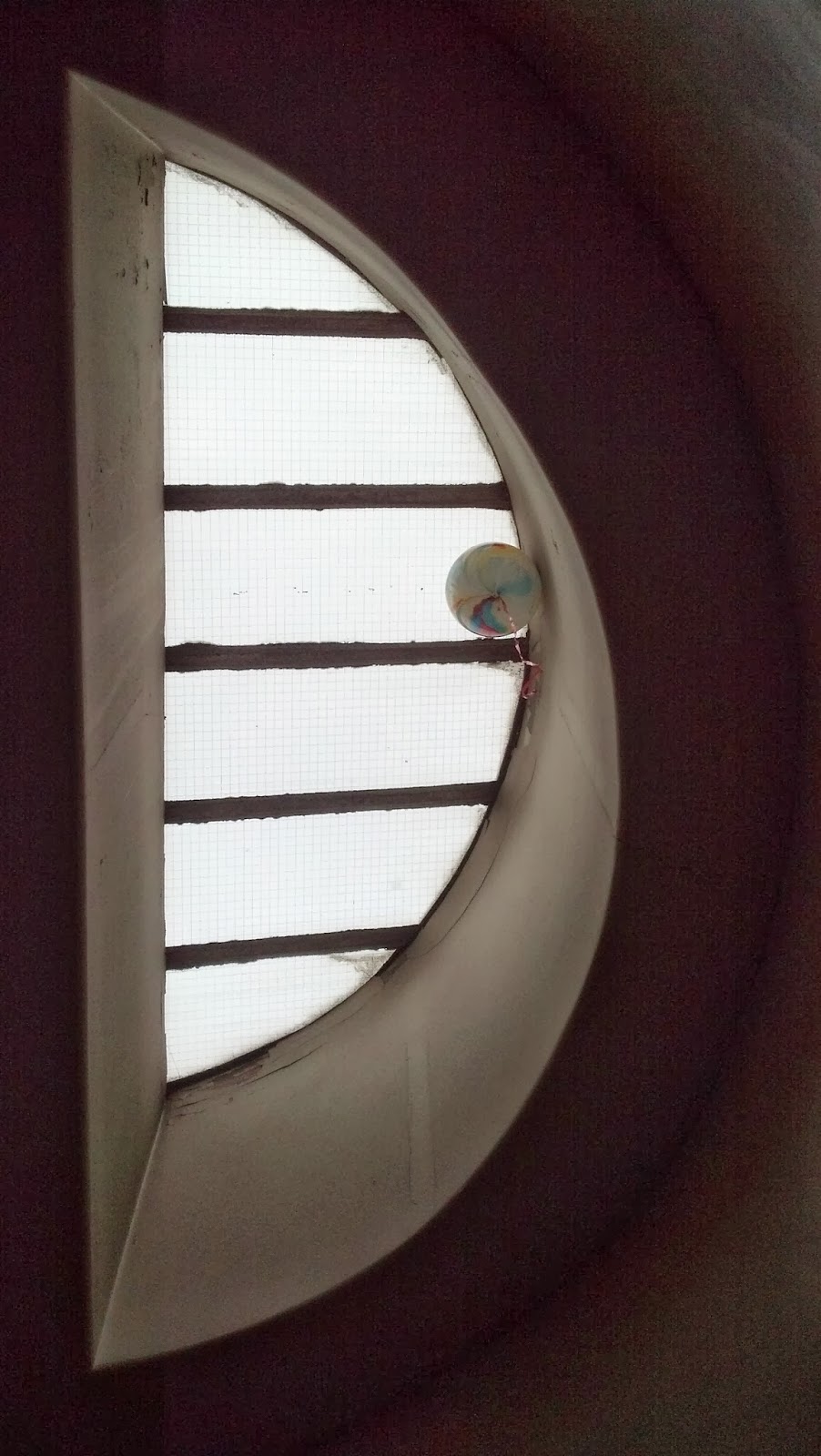 |
| Skylight over the stairs, with a balloon that someone lost. Okay, it was me. |
10.12.2013
marché aux puces.
We did a thoroughly crappy job of buying souvenirs in Europe. We didn't buy very many for ourselves, and we bought even fewer for people back home. I even lugged my extra large suitcase around specifically so I could fill it with trinkets. Most of our souvenirs ended up being ticket stubs.
One trouble is that we didn't really shop much. We saw a million little souvenir stores, but even the thought of going in seemed like a waste of precious Paris time. You know what? They got gift shops at the airport. We went to the various gift shops at the sites we visited, but they too seemed overpriced and a bit generic. I occasionally thought of buying a practical souvenir; when it was rainy or windy, an umbrella or scarf seemed like a good idea. But then the weather would clear up enough that I forgot about it until the next time.
However, we did go to the flea market. Wherever I go, I look for secondhand souvenirs. A t-shirt or hat that says "PARIS" would remind me that we went to Paris once. A secondhand souvenir takes me back to the exact day that I bought it. (Fun fact: the word souvenir is French, for "to remember.")
We went to the market at the Porte de Vanves. It was a pretty nasty day. While the Paris weather was not ideal most of the time we were there, that day was actually sorta miserable. Rainy, windy, cold. Not a good flea market day, even when armed with a hot café crème and a fresh pain au chocolat, but it was our only Saturday, and I came all the way across the Atlantic to go to a real French flea market. Or as they call it, marché aux puces. This literally means "flea market," and the story goes that it got the name because the upholstery of the old furniture sold there was infested with the jumping parasites.
I've basically come across two kinds of flea markets - some with old junk and some with new junk (I use the word "junk" lovingly). New junk tends to be dollar store type stuff, mass produced and poor quality. Old junk is old junk. I love old junk flea markets, while I generally don't bother stopping at new junk places.
The market at Porte de Vanves was old junk, with vendors set up under canopies on the tree-lined sidewalk. The tents mostly kept the merchandise dry, but customers got pretty wet. I stood at one tent, looking through a stack of art prints for a good while, a steady drip of water running off the tent and down my neck.
And really, it was a lot like flea markets in the States. There was a good variety of stuff, plenty of it very tempting. The prices were consistent with other big city markets. Someone had taken apart a very old atlas and was selling the individual pages for 18€ apiece. There was a guy who had a bunch of old tools, and I considered buying an awl, as I've been interested in bookbinding lately. Another vendor had this elephant game, which I really, really wanted.
I did not even bother asking the price, though. Asking the price is the first step toward buying something ridiculous that you don't need. No one needs an elephant game, even one as beautiful and cool as this one. Also, I did not know how to ask "How much?" in French, and though everyone seemed to speak English perfectly well, the language barrier made me shy. (I just looked it up; it's combien.)
I went to the Brooklyn flea market with a friend one time, and she admired my will power. That was also an old junk market, but everything there had been filtered for Brooklyn tastes, so it was all very hip. However, going to yard sales and estate sales means that I know where flea market vendors get their stuff, and I know what they pay for it. So while I enjoy looking at all the neat stuff, I am not usually not interested in paying a middleman for something that I could find for myself eventually.
I did buy a couple of small souvenirs. One booth had a huge box of keychains, the kind businesses give away. I love stuff like this, which is why I have all kinds of t-shirts for places which I have no association. I ended up with this one, 3€.


And I bought two prints from the art dealer for 5€ apiece. There were a ton that I would have liked, but again, not feeling confident in French prevented me from asking about a better price for buying multiples. That was dumb. The guy spoke excellent English. I'll have to come up with frames for them.


Josh also bought a pocket knife for 10€. He has a collection of them. He's pretty cute when he gets a new one, doing all the research he can about its origins. He'll take it out and admire it, asking me repeatedly, "Have you seen my knife?" This one was marked with a brand name, but it's probably a knock-off. Such is my husband the optimist, that he considers even the knock-off status as something to be proud of.
We both paid more than we would have for these same things back home. Paying in euros always feels cheaper than it is. Whatever, we were on vacation. These are our souvenirs. We didn't buy any Eiffel Tower paperweights or Monet scarves, just some goofy things from the flea market. And every time I look at my silly television repair keychain, I'll remember the old men playing poker, the elephant game, the atlas, the whole rainy morning in Paris.
One trouble is that we didn't really shop much. We saw a million little souvenir stores, but even the thought of going in seemed like a waste of precious Paris time. You know what? They got gift shops at the airport. We went to the various gift shops at the sites we visited, but they too seemed overpriced and a bit generic. I occasionally thought of buying a practical souvenir; when it was rainy or windy, an umbrella or scarf seemed like a good idea. But then the weather would clear up enough that I forgot about it until the next time.
However, we did go to the flea market. Wherever I go, I look for secondhand souvenirs. A t-shirt or hat that says "PARIS" would remind me that we went to Paris once. A secondhand souvenir takes me back to the exact day that I bought it. (Fun fact: the word souvenir is French, for "to remember.")
We went to the market at the Porte de Vanves. It was a pretty nasty day. While the Paris weather was not ideal most of the time we were there, that day was actually sorta miserable. Rainy, windy, cold. Not a good flea market day, even when armed with a hot café crème and a fresh pain au chocolat, but it was our only Saturday, and I came all the way across the Atlantic to go to a real French flea market. Or as they call it, marché aux puces. This literally means "flea market," and the story goes that it got the name because the upholstery of the old furniture sold there was infested with the jumping parasites.
I've basically come across two kinds of flea markets - some with old junk and some with new junk (I use the word "junk" lovingly). New junk tends to be dollar store type stuff, mass produced and poor quality. Old junk is old junk. I love old junk flea markets, while I generally don't bother stopping at new junk places.
The market at Porte de Vanves was old junk, with vendors set up under canopies on the tree-lined sidewalk. The tents mostly kept the merchandise dry, but customers got pretty wet. I stood at one tent, looking through a stack of art prints for a good while, a steady drip of water running off the tent and down my neck.
 |
| Old men playing poker in between customers |
 |
| I really can't explain the things that I want, I just want them |
I went to the Brooklyn flea market with a friend one time, and she admired my will power. That was also an old junk market, but everything there had been filtered for Brooklyn tastes, so it was all very hip. However, going to yard sales and estate sales means that I know where flea market vendors get their stuff, and I know what they pay for it. So while I enjoy looking at all the neat stuff, I am not usually not interested in paying a middleman for something that I could find for myself eventually.
I did buy a couple of small souvenirs. One booth had a huge box of keychains, the kind businesses give away. I love stuff like this, which is why I have all kinds of t-shirts for places which I have no association. I ended up with this one, 3€.


And I bought two prints from the art dealer for 5€ apiece. There were a ton that I would have liked, but again, not feeling confident in French prevented me from asking about a better price for buying multiples. That was dumb. The guy spoke excellent English. I'll have to come up with frames for them.


 |
| Thereafter, he opened every bottle of wine while asking, "Have you seen my knife?" |
10.08.2013
do french people?

The joke about the French is that they are smelly. I encountered some smelly French people, usually on the subway at around 6 PM, which is when they all encountered a smelly American. Being all smushed together on a train is not a recipe for pleasant odors. But other than that, I did not notice the French to smell any differently than any other people I've encountered.
However, the French are a bit different when it comes to showering, as we discovered in Lyon.
Every time you go someplace new, getting the shower to work can be a bit confusing. Even in our apartment in Paris, we had a bit of trouble, mostly because the knob in the shower stall was a little sticky, and I was afraid to apply too much force, lest I rip it out of the wall with my brute strength. A friend of mine has anxiety about unfamiliar shower configurations, such that he would use it as a reason to not stay with people that he suspected might have weird plumbing. How you spot such a person, I cannot say.
Are Americans judgmental?
But in the house in Lyon, there was a nice full bathtub and a shower head with a long hose. However, there was no way to attach the shower head to the wall. And there was no shower curtain, which made sense, because if you're pointing the water flow yourself, you can just not spray the bathroom.
I admit that this bathing situation gave me anxiety. I have a routine when I shower, but I found that my system was not really appropriate for this kind of situation. I usually rinse, lather, rinse a series of body areas. To do this in the French bath required turning the water on to rinse, turning it off to lather, then turning it on again to rinse. I felt like I was doing it wrong, but I no idea how I was supposed to do it. As our stay went on, I would try to adjust the order of body parts that I went in, so that I could do all my lathering in one go, followed by a full rinse. I didn't quite manage it, mostly because there is one body part that has to be lathered last, and I did not plan for that. And then our stay was over, and now I'll never know how to bathe in France.
Are Americans complete morons?
Besides not understanding how I was supposed to clean myself, I did not understand why they hadn't just attached the shower head to the wall and bought a bar to hang a curtain. Until in conversation, our friend mentioned that water was really expensive there.
Ding! Er, Click! Bloop? What sound do light bulbs make when they go off, anyway?
That explained why the shower wasn't quite a shower. Confusing as it was for me, I had to admit that I used less water, even after I did accidentally spray it all over the bathroom.
Are Americans messy?
The cost of water affects them in many ways. We were sitting outside at a cafe, having a drink one evening, when Josh pulled out his cigarettes. Our friends were appalled and gave him some statistics about smoking-related deaths, as if maybe he just hadn't heard that it was kinda bad for you. Then we moved on to talking about where you could smoke. Like here in North Carolina, the French can't really smoke in public buildings anymore. As nonsmokers, our friends liked the new rules. They said that before, if you went out at night, you'd come home smelling like smoke and you couldn't even wear the same outfit the next day! I had a private giggle at that. Me, I will frequently wear clothes multiple times between washings. Josh, on the other hand, will wear three different outfits in one day and call them all dirty. Our water comes absolutely free out of the ground.
Are Americans wasteful?
So maybe the French are different about hygiene than we are. But the difference is not in the people themselves. There is not a smelly gene or some kind of congenital nose disease where they just don't know they smell bad. It's because of a totally boring and practical reason. It makes me wonder how many of our other notions about people in other countries could be explained by something as dull as the price of water. If our water was expensive, everyone else would think we were smelly, too.
Instead...

Note: As to the other questions about the French, the answers are, respectively: at least one of them does, many of them do, and not that we saw. You're on your own on the questions about Americans.
10.05.2013
travel woes.
Just to keep it real, here are three bad things that happened on our trip.
Thing 1: The weather
Before we left, I did the smart thing and checked the weather report for where we would be. The internet meteorologists said it would be sunny and in the low 70s during the day, mid 50s at night. That sounds lovely, doesn't it? So I packed accordingly. I brought my standbys of jeans and t-shirts, plus a couple pairs of short pants, tank tops, and two sundresses. I felt like Peppermint Patty in Bon Voyage, Charlie Brown, wondering how many pairs of flip flops she would need in France. Well, you know, one pair for casual, one pair for dressy, maybe even a formal pair?
Just to be sure, I threw in a cardigan for those mid-50s evenings, strolling hand in hand with my beloved in the moonlight.
Did you know that Paris is kind of a rainy place? That is never mentioned in the romantic movies. I am not sure we saw the sun at all in the first five days we were there. It was always cloudy and always just a little bit drizzly. My tank tops and sundresses and flip flops never saw a bit of France. The sweater got a little funky from repeated wear. I apparently lack the basic ability to look up the forecast.
Why it was okay: For the most part, the drizzle never really turned into actual rain. Several times, I considered buying a nice umbrella as a souvenir, but the rain never even got bad enough for that. Plus, we were in Paris, and if you've got to be in lousy weather anywhere, why not the city of light? The very last day we were there was simply glorious, so we did have one beautiful day. I didn't even wear my sweater.
Thing 2: The infection
I got a sinus infection. It began with a tickle in the throat, but pretty soon the snot factory started up. I started carrying tissues and cough drops. I would've taken a decongestant, but the people we were staying with were very down on anything that was not natural, and I decided I'd rather suffer the snot than suffer a lecture.
Why it was okay: I get sinus infections at home. This one was not too awful, mostly just annoying.
Thing 3: The wallet
If you do any research about European travel, you will end up duct taping your valuables to your chest and looking at anyone suspiciously. Apparently they have problems with pickpockets there, and tourists have such wide open pockets, with their wads of cash and their passports, which are valuable on the black market. I bought a money belt to wear under my clothes, but then I never used it. Because in all the hand-wringing about sticky fingers, there were some calm voices that said if you are cautious, you will be fine. Thieves like obvious and easy targets, of which there are plenty. If we did not fit that bill, they'd go bother someone else. I have a particular purse which I like for travelling, because it's big and the strap goes across my body, thwarting snatchers. I probably clutched it nervously more than was necessary, but I did not make myself an easy target. Josh always carries his wallet in his front pocket, a trick he learned from living in New York City. We did not get robbed.
However, Josh wore some pants with deep, but loose pockets. A few hours after we had gotten off the train that took us from Paris to Lyon, Josh discovered that his wallet had not gotten off the train with him. No one had stolen it. He'd lost it. THAT IS NOT BEING A GOOD TRAVELLER. A few days later, he was sitting on a couch with me and his phone did the same shimmy out of his pocket. I started talking about his "loser pants." He did not think that was nearly as funny as I did, but it really helped keep me from strangling him.
Why it was okay: He lost his driver's license, his debit card, and some cash. We were able to cancel the debit card easily. I was in charge of the passports and the rest of the cash, because I don't wear loser pants. It was mostly inconvenient when we got home and had to get new cards, but it didn't affect the trip much.
So really, nothing bad happened. All these things could've happened if we'd just stayed home, too, but we were lucky enough to get to be slightly inconvenienced in France.
Thing 1: The weather
Before we left, I did the smart thing and checked the weather report for where we would be. The internet meteorologists said it would be sunny and in the low 70s during the day, mid 50s at night. That sounds lovely, doesn't it? So I packed accordingly. I brought my standbys of jeans and t-shirts, plus a couple pairs of short pants, tank tops, and two sundresses. I felt like Peppermint Patty in Bon Voyage, Charlie Brown, wondering how many pairs of flip flops she would need in France. Well, you know, one pair for casual, one pair for dressy, maybe even a formal pair?
Did you know that Paris is kind of a rainy place? That is never mentioned in the romantic movies. I am not sure we saw the sun at all in the first five days we were there. It was always cloudy and always just a little bit drizzly. My tank tops and sundresses and flip flops never saw a bit of France. The sweater got a little funky from repeated wear. I apparently lack the basic ability to look up the forecast.
Why it was okay: For the most part, the drizzle never really turned into actual rain. Several times, I considered buying a nice umbrella as a souvenir, but the rain never even got bad enough for that. Plus, we were in Paris, and if you've got to be in lousy weather anywhere, why not the city of light? The very last day we were there was simply glorious, so we did have one beautiful day. I didn't even wear my sweater.
Thing 2: The infection
I got a sinus infection. It began with a tickle in the throat, but pretty soon the snot factory started up. I started carrying tissues and cough drops. I would've taken a decongestant, but the people we were staying with were very down on anything that was not natural, and I decided I'd rather suffer the snot than suffer a lecture.
Why it was okay: I get sinus infections at home. This one was not too awful, mostly just annoying.
Thing 3: The wallet
If you do any research about European travel, you will end up duct taping your valuables to your chest and looking at anyone suspiciously. Apparently they have problems with pickpockets there, and tourists have such wide open pockets, with their wads of cash and their passports, which are valuable on the black market. I bought a money belt to wear under my clothes, but then I never used it. Because in all the hand-wringing about sticky fingers, there were some calm voices that said if you are cautious, you will be fine. Thieves like obvious and easy targets, of which there are plenty. If we did not fit that bill, they'd go bother someone else. I have a particular purse which I like for travelling, because it's big and the strap goes across my body, thwarting snatchers. I probably clutched it nervously more than was necessary, but I did not make myself an easy target. Josh always carries his wallet in his front pocket, a trick he learned from living in New York City. We did not get robbed.
However, Josh wore some pants with deep, but loose pockets. A few hours after we had gotten off the train that took us from Paris to Lyon, Josh discovered that his wallet had not gotten off the train with him. No one had stolen it. He'd lost it. THAT IS NOT BEING A GOOD TRAVELLER. A few days later, he was sitting on a couch with me and his phone did the same shimmy out of his pocket. I started talking about his "loser pants." He did not think that was nearly as funny as I did, but it really helped keep me from strangling him.
Why it was okay: He lost his driver's license, his debit card, and some cash. We were able to cancel the debit card easily. I was in charge of the passports and the rest of the cash, because I don't wear loser pants. It was mostly inconvenient when we got home and had to get new cards, but it didn't affect the trip much.
So really, nothing bad happened. All these things could've happened if we'd just stayed home, too, but we were lucky enough to get to be slightly inconvenienced in France.
10.04.2013
romance is romantic if you've got the answers.
Let's talk romance.
My first impulse is to say that it's overrated. But when I say that, I'm talking about the tired cliches of romance - flowers and hearts, teddy bears and candy, etc. However, the actual definition of romance is anything that makes you feel the emotion of love. That could be anything, and it means lots of different things for different people. So really, I mean that flowers and teddy bears are overrated, and romance is underrated.
Paris is known to be a romantic city, but we did not do any of the romantic things. We saw a lot of art and churches and dead people. But we did have a romantic time, because we are already stupid in love with each other. I would look at something astounding in Paris, and go, "Holy crap, this place is amazing!" Then I would look next to me and think, "And Josh is here, too!" Then came the love feelings.
However, we did do one thing that most everyone would agree was romantic. We put a lock on a bridge.
We took a cruise on the river Seine, which splits the city about in half. In fact, the city used to be contained on an island in the Seine. River cruises are honestly the kind of touristy thing that I would avoid, but I enjoyed this, as it was a good way to see a lot of different sights from afar and understand how they all related to each other. Plus, who doesn't like being on a boat? This just goes to show that I shouldn't be such a snob about being a tourist, when I am, in fact, a tourist.
Another bonus of the river cruise was that it allowed us to get nice views and background information on the many bridges in the city. There was a recorded guide that told information about the bridges and the other various sights we were passing, but it was a little hard to follow, because it was recorded in seven different languages. So I kept missing the English portion because I had tuned out during the French, German, Italian, Spanish, Chinese, and Japanese parts.

There was one bridge, however, where the railing and fence was shining in an odd way, shimmering almost. As we got closer and then went under, I realized that the bridge was covered in padlocks. Huh? That night, when we got back to the apartment (and more importantly, to the wifi), I looked it up. Turns out, they're love locks. Awwww.
What you do is you get a lock, the kind you open with a key. This lock is a symbol of your love. So you take your beloved and your love lock and you put the love lock on the bridge and then toss the keys into the Seine. Do not toss your beloved into the Seine. There are two such bridges in Paris, one where you went with your lover and one where you went with someone you were committed to, like a spouse. The article I was reading then went on to quote some ill-mannered waiter who complained that this was not the French idea of love at all, which is where you love someone so much that you tell them to go have affairs and such. I would point out to this waiter that when I got married, I was not binding Josh to me, I was binding myself to him. It just worked out that he was also binding himself to me on the same day, which really cut down on expenses. But that waiter was probably just mad at his girlfriend for wanting him to commit already.
Once (or maybe once in a while), the city will go and cut down the fence and put up a new one, but those silly lovers just put more up.

Anyway, Josh thought this whole lock thing sounded sweet, and so we set out to do a little romantic vandalism. The article helpfully told which bridge was for your wife (Pont des Arts) and which one was for your mistress, and also that there was a huge department store nearby where you could buy a lock. We found the hardware section and picked out a lock. Never in any of my Paris dreams did I imagine a hardware department being involved. I was in favor of the absolute cheapest one, but Josh wanted a weird-looking one that cost twice as much. We got the weird one, since I'm a sucker and it's supposed to symbolize our love or something.
When we got to the bridge, we found that there were entrepreneurs who had bought multi-packs of locks at the same department store and would've sold us one, plus lent us a Sharpie to write our names on it. Oh well. Instead, Josh pulled out the knife he'd bought at the marche aux puces (flea market) the previous weekend and set to work engraving our names. It would have taken a long time to really do a bang-up job on it, but we are hoping that spending more on the lock would make up for our lack of effort on the engraving.

And then he put our lock on the bridge, all mixed up with all the other romantic suckers who had visited Paris. Then, taking a furtive look around, I threw the keys into the river. We smiled and walked away holding hands. It was pretty romantic.

Paris is known to be a romantic city, but we did not do any of the romantic things. We saw a lot of art and churches and dead people. But we did have a romantic time, because we are already stupid in love with each other. I would look at something astounding in Paris, and go, "Holy crap, this place is amazing!" Then I would look next to me and think, "And Josh is here, too!" Then came the love feelings.
However, we did do one thing that most everyone would agree was romantic. We put a lock on a bridge.
We took a cruise on the river Seine, which splits the city about in half. In fact, the city used to be contained on an island in the Seine. River cruises are honestly the kind of touristy thing that I would avoid, but I enjoyed this, as it was a good way to see a lot of different sights from afar and understand how they all related to each other. Plus, who doesn't like being on a boat? This just goes to show that I shouldn't be such a snob about being a tourist, when I am, in fact, a tourist.
Another bonus of the river cruise was that it allowed us to get nice views and background information on the many bridges in the city. There was a recorded guide that told information about the bridges and the other various sights we were passing, but it was a little hard to follow, because it was recorded in seven different languages. So I kept missing the English portion because I had tuned out during the French, German, Italian, Spanish, Chinese, and Japanese parts.

There was one bridge, however, where the railing and fence was shining in an odd way, shimmering almost. As we got closer and then went under, I realized that the bridge was covered in padlocks. Huh? That night, when we got back to the apartment (and more importantly, to the wifi), I looked it up. Turns out, they're love locks. Awwww.
What you do is you get a lock, the kind you open with a key. This lock is a symbol of your love. So you take your beloved and your love lock and you put the love lock on the bridge and then toss the keys into the Seine. Do not toss your beloved into the Seine. There are two such bridges in Paris, one where you went with your lover and one where you went with someone you were committed to, like a spouse. The article I was reading then went on to quote some ill-mannered waiter who complained that this was not the French idea of love at all, which is where you love someone so much that you tell them to go have affairs and such. I would point out to this waiter that when I got married, I was not binding Josh to me, I was binding myself to him. It just worked out that he was also binding himself to me on the same day, which really cut down on expenses. But that waiter was probably just mad at his girlfriend for wanting him to commit already.
 |
| Ya know, I think Kyle and Megan are going to make it |
Once (or maybe once in a while), the city will go and cut down the fence and put up a new one, but those silly lovers just put more up.

Anyway, Josh thought this whole lock thing sounded sweet, and so we set out to do a little romantic vandalism. The article helpfully told which bridge was for your wife (Pont des Arts) and which one was for your mistress, and also that there was a huge department store nearby where you could buy a lock. We found the hardware section and picked out a lock. Never in any of my Paris dreams did I imagine a hardware department being involved. I was in favor of the absolute cheapest one, but Josh wanted a weird-looking one that cost twice as much. We got the weird one, since I'm a sucker and it's supposed to symbolize our love or something.
 |
| A weird symbol of our weird love. |
When we got to the bridge, we found that there were entrepreneurs who had bought multi-packs of locks at the same department store and would've sold us one, plus lent us a Sharpie to write our names on it. Oh well. Instead, Josh pulled out the knife he'd bought at the marche aux puces (flea market) the previous weekend and set to work engraving our names. It would have taken a long time to really do a bang-up job on it, but we are hoping that spending more on the lock would make up for our lack of effort on the engraving.

And then he put our lock on the bridge, all mixed up with all the other romantic suckers who had visited Paris. Then, taking a furtive look around, I threw the keys into the river. We smiled and walked away holding hands. It was pretty romantic.

10.03.2013
tour saint jacques.
The thing about Paris is that if you just look down a street, you're bound to see something impressive. If you're like me, you want to feel smart, so you take a guess at what it might be. If you continue to be like me, you don't actually know that much, and so you end up guessing one of a handful of things that you know are in Paris. So if it's a church, you guess Notre Dame, and if it's a huge old building, you guess the Louvre. If it's a ginormous metal tower, you guess the Eiffel Tower, and you are probably right about that one.
We planned things as we went in Paris, and that meant a lot of random meandering. You see a cool thing down the street, you go look at it, lather rinse repeat, until you've walked all day long. Luckily, there are cafes all along the way, and it is perfectly acceptable in Paris to be drinking either coffee or alcohol at all times of day. Once we saw a man having a glass of wine and a cup of espresso at nine o'clock in the morning.
One of the cool things we saw down the street was the Saint Jacques Tower. Built in the early 16th century, there used to be a church attached. However, the church was demolished for its building materials after the revolution. It was built to honor St James the Great, better known as James, son of Zebedee. You know, one of those guys that hung out with Jesus. Turns out, he is the patron saint of Spain, because he made it all the way to Iberia, preaching the good news.* There are pilgrimage routes from all over Europe leading to the place where his remains are contained in Santiago de Compostela. The tower in Paris is the starting points of one of these routes. Supposedly, there is a relic, a piece of St James' body, inside the tower. We were not able to find out what it was, but we did make jokes about a finger bone. St James had a sense of humor, right?

The tower itself is really beautiful. Paris is lousy with huge old buildings, but this particular one is in what is known as the flamboyant gothic style. I admired the gargoyles in particular. If I ever get my own flamboyant gothic tower, I want gargoyles like that. At the base of the tower is a statue of...Blaise Pascal (there is a statue of St James on top of the tower). Pascal did some important experiments in atmospheric pressure there (maybe, it might have been at another church instead, because history is confusing).

Entrance to the tower was barred by an iron gate, with a sign that said tours would happen every hour on the hour. They let seventeen people in at a time. I was not particularly interested in waiting in line or climbing three hundred stairs. However, Josh, who had never heard of Saint Jacques Tower half an hour previously, suddenly had his heart set on seeing the finger bone of an apostle. In fact, this was the last day of the season that the tower would be open to visitors, and since it was sort of fragile, there was talk of closing it down to the public for good. We waited outside the fence with a small crowd. A couple of times, a soft-spoken man came out and said something in French which would cause most everyone else to disperse. Only until we were standing next to someone bilingual did we find out that we needed tickets to get in, and all this standing around looking hopeful wasn't going to do any good.

So we walked around the tower and took some pictures. Then we saw something cool down the street and walked that-a-way.
*Supposedly, he later appeared to fight with the Christian army against the Muslims, where he picked up the nickname "Moor-slayer," which doesn't seem like the kind of thing that Jesus would be about. However, if you look up this battle, the first thing you'll read is that it never happened. Religion is confusing.
We planned things as we went in Paris, and that meant a lot of random meandering. You see a cool thing down the street, you go look at it, lather rinse repeat, until you've walked all day long. Luckily, there are cafes all along the way, and it is perfectly acceptable in Paris to be drinking either coffee or alcohol at all times of day. Once we saw a man having a glass of wine and a cup of espresso at nine o'clock in the morning.
One of the cool things we saw down the street was the Saint Jacques Tower. Built in the early 16th century, there used to be a church attached. However, the church was demolished for its building materials after the revolution. It was built to honor St James the Great, better known as James, son of Zebedee. You know, one of those guys that hung out with Jesus. Turns out, he is the patron saint of Spain, because he made it all the way to Iberia, preaching the good news.* There are pilgrimage routes from all over Europe leading to the place where his remains are contained in Santiago de Compostela. The tower in Paris is the starting points of one of these routes. Supposedly, there is a relic, a piece of St James' body, inside the tower. We were not able to find out what it was, but we did make jokes about a finger bone. St James had a sense of humor, right?

The tower itself is really beautiful. Paris is lousy with huge old buildings, but this particular one is in what is known as the flamboyant gothic style. I admired the gargoyles in particular. If I ever get my own flamboyant gothic tower, I want gargoyles like that. At the base of the tower is a statue of...Blaise Pascal (there is a statue of St James on top of the tower). Pascal did some important experiments in atmospheric pressure there (maybe, it might have been at another church instead, because history is confusing).

Entrance to the tower was barred by an iron gate, with a sign that said tours would happen every hour on the hour. They let seventeen people in at a time. I was not particularly interested in waiting in line or climbing three hundred stairs. However, Josh, who had never heard of Saint Jacques Tower half an hour previously, suddenly had his heart set on seeing the finger bone of an apostle. In fact, this was the last day of the season that the tower would be open to visitors, and since it was sort of fragile, there was talk of closing it down to the public for good. We waited outside the fence with a small crowd. A couple of times, a soft-spoken man came out and said something in French which would cause most everyone else to disperse. Only until we were standing next to someone bilingual did we find out that we needed tickets to get in, and all this standing around looking hopeful wasn't going to do any good.

So we walked around the tower and took some pictures. Then we saw something cool down the street and walked that-a-way.
*Supposedly, he later appeared to fight with the Christian army against the Muslims, where he picked up the nickname "Moor-slayer," which doesn't seem like the kind of thing that Jesus would be about. However, if you look up this battle, the first thing you'll read is that it never happened. Religion is confusing.
9.30.2013
september 2013 books
I did not get a lot of reading done this month, or rather, I did not finish as many books as usual.
Gargantua and Pantagruel
François Rabelais
In The Music Man, the Iowan townsfolk complain about the kind of smutty books kept in the town library and promoted by the librarian there. They specifically complain - in song, of course - about Rabelais. All of the authors they sneer at are undisputed classics, and so you're meant to roll your eyes at the silly uneducated people who don't understand what literature is about. I have to say, though, that this book is bawdy. Hands down, the dirtiest book I have ever read. Everyone is always drunk and having sex and drowning people in their urine. Next time someone complains about the coarsening of society, I'll just hand them this book from the 16th century. Rabelais could teach them a thing or two about fart jokes.
Okay, I did not finish this book. I read Gargantua, and got maybe a fifth into Pantagruel before I just gave it up. Not that I was offended, but really, so much of the book is devoted to the bawdiness that I was simply not enjoying it. With 400 pages to go, I concluded that I would rather put Rabelais on hold and read something else. Don't take that as me agreeing with the prudish ladies of Iowa. The humor was clever, the satire pointed, and I can't dispute Rabelais' contribution to language and literature. I just don't want to read it at this point in my life. Maybe someday I will be ready for Rabelais.
Penguin Island
Anatole France
This was a very strange (and good!) book. I don't think I've ever read one like it. It is a historical text of the inhabitants of Penguin Island. It starts with a creation story, which includes a scene in Heaven where God and various saints and theologians throughout history discuss what to do about the penguins. See, they're actual penguins, but this pious and half-blind monk accidentally baptized them. This caused a crisis in heaven, which God solved by giving the monk the power to ensoul the penguins and make them people. Then the penguins start wearing clothes and killing each other over property, just like regular people.
After the creation story, there are histories that deal with saints and dragons, geneaologies, stories of the great kings, a revolution, and a couple attempts to restore the monarchy. Each episode is written in a different sort of style, as if written by a different author in a different era. The creation story is told like a legend, parts of it are straight-forward histories, and other parts are more like journalism. The various events parallels real events that happened throughout European history. While the penguins are taken to be a single group of people, their history could be the history of all humans. A thoroughly fun and strange little book.
Little Lord Fauntleroy
Frances Hodgson Burnett
This book is not set in France, nor is the author French, though she is named Frances. But this book is not part of my study of France through literature. Since the trip is over, I can go back to reading whatever I want. I packed this one for the trip because it was light. A bit too light, as I finished the whole thing on one train ride.
The title character is synonymous now with fancy velvet suits and ruffled collars, and being called a Little Lord Fauntleroy now would not be so complimentary. While the character did dress that way, his defining trait was his sweet nature. The book is about an American child who finds out that he is to inherit an earlship, so he goes to his ancestral home to live with his grandfather, the current earl. The old man is very grumpy and bitter after having lived a life of selfishness, but through his interaction with Little Lord Fauntleroy, he learns to love and becomes a much nicer person.
I've read A Little Princess by the same author and have seen the movie for The Secret Garden, and while the plots are different, the messages are basically the same. Be kind and loving and good things will happen to you. Be a jerk and you'll be miserable until someone kind and loving comes along to redeem you and teach you to be kind and loving. Sometimes the characters are sort of impossibly good, which makes me despair that I can ever be so kind and so loving. But they do provide a model that I want to strive toward. Besides, they never say that Little Lord Fauntleroy wasn't a jerk sometimes when he was having a bad day. That just wasn't in the book, and I'm sure he felt real bad about it afterwards.
And that's it for this month. I also started reading Tristam Shandy, but then Josh ran out of books to read on the trip, and he took it (after reading Little Lord Fauntleroy). He then kept it, so I guess I'll get back to it when he's done with it. I have not yet come up with some sort of theme to use to pick my next books. I used a country before, which worked pretty well. I could do that again, or go with subject matter or even time period. Suggestions welcome.
Gargantua and Pantagruel
François Rabelais
In The Music Man, the Iowan townsfolk complain about the kind of smutty books kept in the town library and promoted by the librarian there. They specifically complain - in song, of course - about Rabelais. All of the authors they sneer at are undisputed classics, and so you're meant to roll your eyes at the silly uneducated people who don't understand what literature is about. I have to say, though, that this book is bawdy. Hands down, the dirtiest book I have ever read. Everyone is always drunk and having sex and drowning people in their urine. Next time someone complains about the coarsening of society, I'll just hand them this book from the 16th century. Rabelais could teach them a thing or two about fart jokes.
Okay, I did not finish this book. I read Gargantua, and got maybe a fifth into Pantagruel before I just gave it up. Not that I was offended, but really, so much of the book is devoted to the bawdiness that I was simply not enjoying it. With 400 pages to go, I concluded that I would rather put Rabelais on hold and read something else. Don't take that as me agreeing with the prudish ladies of Iowa. The humor was clever, the satire pointed, and I can't dispute Rabelais' contribution to language and literature. I just don't want to read it at this point in my life. Maybe someday I will be ready for Rabelais.
Penguin Island
Anatole France
This was a very strange (and good!) book. I don't think I've ever read one like it. It is a historical text of the inhabitants of Penguin Island. It starts with a creation story, which includes a scene in Heaven where God and various saints and theologians throughout history discuss what to do about the penguins. See, they're actual penguins, but this pious and half-blind monk accidentally baptized them. This caused a crisis in heaven, which God solved by giving the monk the power to ensoul the penguins and make them people. Then the penguins start wearing clothes and killing each other over property, just like regular people.
After the creation story, there are histories that deal with saints and dragons, geneaologies, stories of the great kings, a revolution, and a couple attempts to restore the monarchy. Each episode is written in a different sort of style, as if written by a different author in a different era. The creation story is told like a legend, parts of it are straight-forward histories, and other parts are more like journalism. The various events parallels real events that happened throughout European history. While the penguins are taken to be a single group of people, their history could be the history of all humans. A thoroughly fun and strange little book.
Little Lord Fauntleroy
Frances Hodgson Burnett
This book is not set in France, nor is the author French, though she is named Frances. But this book is not part of my study of France through literature. Since the trip is over, I can go back to reading whatever I want. I packed this one for the trip because it was light. A bit too light, as I finished the whole thing on one train ride.
The title character is synonymous now with fancy velvet suits and ruffled collars, and being called a Little Lord Fauntleroy now would not be so complimentary. While the character did dress that way, his defining trait was his sweet nature. The book is about an American child who finds out that he is to inherit an earlship, so he goes to his ancestral home to live with his grandfather, the current earl. The old man is very grumpy and bitter after having lived a life of selfishness, but through his interaction with Little Lord Fauntleroy, he learns to love and becomes a much nicer person.
I've read A Little Princess by the same author and have seen the movie for The Secret Garden, and while the plots are different, the messages are basically the same. Be kind and loving and good things will happen to you. Be a jerk and you'll be miserable until someone kind and loving comes along to redeem you and teach you to be kind and loving. Sometimes the characters are sort of impossibly good, which makes me despair that I can ever be so kind and so loving. But they do provide a model that I want to strive toward. Besides, they never say that Little Lord Fauntleroy wasn't a jerk sometimes when he was having a bad day. That just wasn't in the book, and I'm sure he felt real bad about it afterwards.
And that's it for this month. I also started reading Tristam Shandy, but then Josh ran out of books to read on the trip, and he took it (after reading Little Lord Fauntleroy). He then kept it, so I guess I'll get back to it when he's done with it. I have not yet come up with some sort of theme to use to pick my next books. I used a country before, which worked pretty well. I could do that again, or go with subject matter or even time period. Suggestions welcome.
9.29.2013
the boneyard.
I had a strong aversion to doing anything that involved standing in a line in Paris. All of the big sites have outrageous lines. Sometimes there are two lines - a ridiculously long one and then a slightly shorter line for people who bought their tickets ahead of time. Instead, we spent a lot of time in places where there was no line at all. Some of them were even free! When there are free things with no waiting, you can see how I'd look at a line of people and then just keep walking.
However, there was one place where we waited in line for two hours in the rain. We really wanted to go to the catacombs.
I know, you are admiring how romantic we are. A honeymoon in Paris! That's gotta be all candlelight and accordion music and cruises on the Seine right? Or whatever people in Paris do for romance. I have no idea, because we were walking around in tunnels looking at bones.
Besides an afternoon walking around and eating bread, another vacation event that has really affected the way I travel is my visit to Eastern State Penitentiary in Philadelphia. Since then, I have been much more interested in what you might call dark tourism. The prison was dark and sad, but strangely beautiful. I could not get the experience out of my head.
I don't seek out dark stuff intentionally. I just don't avoid it. I want to see something interesting. I want to have my mind blown.
Underneath the city of Paris run a series of stone mines, where they got the rock to build the city. In the late 18th century, dead people were getting to be a problem. The cemeteries in the city did not have room to expand, so they started making mass graves. But soon these got full. There were charnel houses which also held the remains of people who had been previously buried and then exhumed to make room for the more recently deceased. It got pretty gross.
Eventually, the city opened three new cemeteries that were outside the central city, and then they decided to turn the old stone mines into an ossuary, a holding place for skeletal remains. It took two years to move all the bones. At first it was just a big jumble of bones, but someone got creative and organized them so they looked nice. Well, you know. Nice for a bunch of bones. They added tombstones and other decorations to give a bit of dignity to those interred there.
After descending a long spiral staircase, we walked around in some of the tunnels. There was a well of crystal clear water and a place where an old miner had carved a city into the rock. Finally, we came to a doorway, which said "Arrete! C'est ici l'empire de la Mort." Stop! Here lies the empire of Death.
 And then it's bones, bones, bones. The tunnel walls are bones - femurs stacked on tibias, with layers of skulls in between. There were designs made of bones, from stripes to hearts and crosses. The bones were stacked about shoulder-high, and behind them was the rest of the skeletons, all piled together. The remains of six million people are in these tunnels. I can't say for sure if I'd ever seen a real human bone before, but I've seen a lot now. I saw the lines where the different bones of the skull meet. And I saw where other dark tourists had written their names on the skulls. I'd apologize to the dead for that, but they used to be people, too, and some of them were probably the type to deface an anonymous skull.

I realized later that what we had seen was a mass grave. Usually, our context for a mass grave is mass murder, where a group is seen as less than human and eliminated. Putting them all together in one big hole, nothing to identify or distinguish them completes the dehumanization. Yet here is a mass grave with no horrifying event to account for all the dead. No massacre, no battle, no plague. Just a solution to a logistical problem in city planning. It's downright banal.
I think what bothers us about mass graves is how thoroughly anonymous they are. There is no registry somewhere that lists the six million names that accompanied those skeletons. They're not even separated into individuals. So one person might be spread out all over the tunnels - an ulna here, a patella there, here a phalange, there a phalange. There is nothing to distinguish anyone from anyone else. Supposedly, Rabelais, one of the founders of modern literature, is down there, but you'd never find him amongst the blacksmiths and the millers and the bakers. From our modern, highly-individualistic society, it hurts the ego to think that we might end up all jumbled together with random people, nothing to commemorate our lives.
Except they're just bones, the only parts of us which survive decomposition. They are not us, because our bodies were never us, and a granite stone with an epitaph wouldn't change that.
However, there was one place where we waited in line for two hours in the rain. We really wanted to go to the catacombs.
I know, you are admiring how romantic we are. A honeymoon in Paris! That's gotta be all candlelight and accordion music and cruises on the Seine right? Or whatever people in Paris do for romance. I have no idea, because we were walking around in tunnels looking at bones.
Besides an afternoon walking around and eating bread, another vacation event that has really affected the way I travel is my visit to Eastern State Penitentiary in Philadelphia. Since then, I have been much more interested in what you might call dark tourism. The prison was dark and sad, but strangely beautiful. I could not get the experience out of my head.
I don't seek out dark stuff intentionally. I just don't avoid it. I want to see something interesting. I want to have my mind blown.
Underneath the city of Paris run a series of stone mines, where they got the rock to build the city. In the late 18th century, dead people were getting to be a problem. The cemeteries in the city did not have room to expand, so they started making mass graves. But soon these got full. There were charnel houses which also held the remains of people who had been previously buried and then exhumed to make room for the more recently deceased. It got pretty gross.
Eventually, the city opened three new cemeteries that were outside the central city, and then they decided to turn the old stone mines into an ossuary, a holding place for skeletal remains. It took two years to move all the bones. At first it was just a big jumble of bones, but someone got creative and organized them so they looked nice. Well, you know. Nice for a bunch of bones. They added tombstones and other decorations to give a bit of dignity to those interred there.
After descending a long spiral staircase, we walked around in some of the tunnels. There was a well of crystal clear water and a place where an old miner had carved a city into the rock. Finally, we came to a doorway, which said "Arrete! C'est ici l'empire de la Mort." Stop! Here lies the empire of Death.


I realized later that what we had seen was a mass grave. Usually, our context for a mass grave is mass murder, where a group is seen as less than human and eliminated. Putting them all together in one big hole, nothing to identify or distinguish them completes the dehumanization. Yet here is a mass grave with no horrifying event to account for all the dead. No massacre, no battle, no plague. Just a solution to a logistical problem in city planning. It's downright banal.
I think what bothers us about mass graves is how thoroughly anonymous they are. There is no registry somewhere that lists the six million names that accompanied those skeletons. They're not even separated into individuals. So one person might be spread out all over the tunnels - an ulna here, a patella there, here a phalange, there a phalange. There is nothing to distinguish anyone from anyone else. Supposedly, Rabelais, one of the founders of modern literature, is down there, but you'd never find him amongst the blacksmiths and the millers and the bakers. From our modern, highly-individualistic society, it hurts the ego to think that we might end up all jumbled together with random people, nothing to commemorate our lives.
Except they're just bones, the only parts of us which survive decomposition. They are not us, because our bodies were never us, and a granite stone with an epitaph wouldn't change that.
9.26.2013
home again, home again.
I just got back from France, and boy, are my arms tired. Plus my eyes, from all the looking, and my feet, from all the walking, and my jaw, from all the eating. Also my nose, because I caught a bonafide Parisian sinus infection. So really, my arms had it easy.
We spent a week in Paris, took a day to hop over to Amsterdam, and then another week in a little village outside Lyons. Our destinations were chosen on the same basis: we knew people in those places. Knowing the locals is a great way to travel, because they can take you to the cool spots. Plus, sometimes they can provide you with a bed/futon/tent, which helps on expenses. If they really like you, they may feed you.
We like to keep a loose schedule when we travel. I've been on trips where everything was scheduled down to the minute, and it seems like you spend more time thinking about the schedule than you do enjoying whatever you're actually doing. The fun happens when you let your trip be a journey, rather than a series of destinations.
I've been to France before, back when I was thirteen years old. We'd come from an overnight flight, and were waiting in a train station for a train to Rome (we'd spend time in Paris later in the trip). We were all sleep-deprived and hungry. I think I was kinda delirious actually, past the whiny stage, and basically just a walking zombie. We had hours to sit in a train station, but we decided to go take a walk instead, because there was Paris outside. So we left the Gare du Nord and strolled the streets of the 10th arrondissement. We went to a bakery and ordered a baguette and ate it by tearing off big chunks with our teeth. It was just what we needed. And it was seriously one of the best moments on the whole vacation. That memory has guided my trip planning ever since. I research things to do, and then we decide what we do when we're there. We don't get to everything, and we find things we didn't even know about.
Josh has never been to France; in fact, he'd never been to any foreign country. When we were thinking of things to do in the city of light, I was ho-hum about doing the touristy things: the Louvre, the Eiffel Tower, Notre Dame. I don't like being told that there are things that I have to do. It makes a vacation seem little more than a checklist. But I worried that it was because I had already done those things and that Josh would feel he would be missing out. But we talked it out, and he said that if all we did was sit at a cafe and drink wine the whole time, he'd be happy. That's Josh, being a good traveler (and a hearty drinker). He enjoys what he does instead of wondering about what he's missed. That's how I see it, too. If you spend a week in Paris and come home bemoaning the things you did not do, then you are looking at it the wrong way.
Travelling can be a real test on a relationship. Being out of your element, not to mention possibly sleep-deprived and stressed, many of your deep and less civilized traits can rear their ugly heads. You have to really like each other in the first place if you want to come out as friends in the end.
There were a couple times during the trip when Josh looked at me and said, "You're not a good traveler." Well, no, when we are about to miss a train and someone stops to take a picture of the security camera which looks like an eye, then, no, I am not a good traveler. There seems to be two parts to being a good traveler: being where you need to be when you need to be there, and then being easy-going about the things that will happen to you. Josh and I are both good at exactly one of those two things. It seems to work out. I get him on the train, and he keeps me calm. I pad the schedule so that he can stop to take pictures of security cameras, and he doesn't fight me when I say we need to go or we will miss the train.
 Anyway, we took a honeymoon to France and came back still married. I'll tell you all about it.
We spent a week in Paris, took a day to hop over to Amsterdam, and then another week in a little village outside Lyons. Our destinations were chosen on the same basis: we knew people in those places. Knowing the locals is a great way to travel, because they can take you to the cool spots. Plus, sometimes they can provide you with a bed/futon/tent, which helps on expenses. If they really like you, they may feed you.
We like to keep a loose schedule when we travel. I've been on trips where everything was scheduled down to the minute, and it seems like you spend more time thinking about the schedule than you do enjoying whatever you're actually doing. The fun happens when you let your trip be a journey, rather than a series of destinations.
I've been to France before, back when I was thirteen years old. We'd come from an overnight flight, and were waiting in a train station for a train to Rome (we'd spend time in Paris later in the trip). We were all sleep-deprived and hungry. I think I was kinda delirious actually, past the whiny stage, and basically just a walking zombie. We had hours to sit in a train station, but we decided to go take a walk instead, because there was Paris outside. So we left the Gare du Nord and strolled the streets of the 10th arrondissement. We went to a bakery and ordered a baguette and ate it by tearing off big chunks with our teeth. It was just what we needed. And it was seriously one of the best moments on the whole vacation. That memory has guided my trip planning ever since. I research things to do, and then we decide what we do when we're there. We don't get to everything, and we find things we didn't even know about.
Josh has never been to France; in fact, he'd never been to any foreign country. When we were thinking of things to do in the city of light, I was ho-hum about doing the touristy things: the Louvre, the Eiffel Tower, Notre Dame. I don't like being told that there are things that I have to do. It makes a vacation seem little more than a checklist. But I worried that it was because I had already done those things and that Josh would feel he would be missing out. But we talked it out, and he said that if all we did was sit at a cafe and drink wine the whole time, he'd be happy. That's Josh, being a good traveler (and a hearty drinker). He enjoys what he does instead of wondering about what he's missed. That's how I see it, too. If you spend a week in Paris and come home bemoaning the things you did not do, then you are looking at it the wrong way.
Travelling can be a real test on a relationship. Being out of your element, not to mention possibly sleep-deprived and stressed, many of your deep and less civilized traits can rear their ugly heads. You have to really like each other in the first place if you want to come out as friends in the end.
There were a couple times during the trip when Josh looked at me and said, "You're not a good traveler." Well, no, when we are about to miss a train and someone stops to take a picture of the security camera which looks like an eye, then, no, I am not a good traveler. There seems to be two parts to being a good traveler: being where you need to be when you need to be there, and then being easy-going about the things that will happen to you. Josh and I are both good at exactly one of those two things. It seems to work out. I get him on the train, and he keeps me calm. I pad the schedule so that he can stop to take pictures of security cameras, and he doesn't fight me when I say we need to go or we will miss the train.

8.31.2013
august 2013 books
Madame Bovary
Gustave Flaubert
This book is supposed to be a masterpiece, but I did not enjoy it. I kept waiting for...something? I think I was waiting for the point, and it just never happened. That's what I get for reading philosophical novels; I now expect all fictional characters to discuss what to do in an existential crisis. It was a simple story, straight-forwardly told. So I did what I always do when a supposedly great book leaves me unimpressed. I looked it up. Sometimes I have to look up books that I have just read. Seems kinda inefficient.
Part of the big deal was the historal significance. It turns out that Flaubert basically invented the modern narrator. In fact, part of what seems so humdrum about it is because tons of writers after Flaubert picked up his narrative style. When I read Jacques the Fatalist, we talked about how novels developed, and how Diderot's novel was not like any novel I'd ever read. And maybe if things had gone differently, budding novelists of the nineteenth century would have imitated Diderot, and all novels would be a series of half-told intersecting stories. As it turns out, those novelists read Flaubert, and so now Madame Bovary seems like a boring book to me because I've read so many imitators. Not that those guys knew they were imitating Flaubert, they were just writing a novel and that's what a novel is supposed to be like. Got that?
I also found out that Flaubert's prose is considered to be flawless. Ah, crap, I was supposed to be paying attention to the writing! I feel like I need someone to tell me what I'm supposed to be getting out of these books before I read them. I don't seem to be very good at noticing it for myself.
Flaubert was known as a perfectionist, always searching for le mot juste, "the precise word." For each word, a writer has a choice of several synonyms or near-synonyms, depending on what he wants to say and how he wants to say it. Unfortunately for me, reading at that level is beyond my current development as a reader. I know that Josh will sit and contemplate a sentence for a long time, pondering why someone might use one word over another. I've never done that in my life, and I never knew that anyone did that until I started going out with a poet. And if that is what one needs to do to fully appreciate Flaubert, I honestly don't know if I will ever get there. I'm sorry, Gustave.
Another part of the problem is that I had a hard time relating to Emma Bovary. She is perpetually disatisfied with her provincial life, and so she has affairs and spends a bunch of money on credit. The point of literature is not whether or not you like the characters, I know that, but characters who cheat on their nice, though dull, husbands and characters who are bad with money have to be some of my least favorite. In hindsight, I was able to appreciate the character development, as Emma went from naive to vaguely disappointed to haughty and cruel. I can tell it's good characterization when each thing that she does seems inevitable because that's who she is.
What was so revolutionary about Flaubert's narration is that he does not judge, he only tells the story. While Emma's actions actions do catch up with her, even that seems like an expression of her character more than some kind of justice. In fact, the book was put on trial for obscenity because Flaubert did not condemn adultery. It's not good enough to tell a story about a disillusioned lady who falls into sin and then dies horribly, you have to say good riddance to bad rubbish. Apparently the readers of the time had similar difficulties about telling a story vs liking the characters. They had a good excuse, though, since Flaubert had just invented it. Me, I'm just slow.
I did pick out this quote, because I thought it was lovely:
"Human speech is like a cracked tin kettle, on which we hammer out tunes to make bears dance when we long to move the stars."
I feel ya there, Gustave.
20,000 Leagues Under the Sea
Jules Verne
Verne is known as one of the fathers of science fiction. One thing that I have noticed these past few months is how historically significant many of these French dudes have been in the development of literature. Good job, France!
A brief plot summary: There has been a giant sea creature sighted, and it's been wrecking ships. Our narrator, a natural historian by the name of Professor Arronax, speculates that it's a giant narwhal. Since he's the expert, he is invited on a mission to hunt and kill it. They finally find it, but in the course of battle, the Professor, his servant, and a harpooner are thrown overboard. They end up on the narwhal, which they discover is not a giant horned sea mammal at all, but a submarine. They are brought inside the Nautilus, where they meet Captain Nemo, who tells them that now that they know the secret of the Nautilus, they can never leave. The bulk of the book is made up of their adventures with Captain Nemo. They sail all over the world, visiting underwater forests, coral reefs, the South Pole.
After having read the book, I found out that the particular translation I was reading, known as the "classic translation," is quite poor. Due to these bad versions, the English-speaking world thinks of Verne as a kiddie author moreso than a literary figure. Sacre bleu!
To be honest, while the adventures were great, there was a lot of just describing fish, which was less exciting. Since Verne's time, we've explored the earth a bit more, and so a lot of the stories seem quaintly obsolete. A lot of it was just giant creatures. He knew about the regular specimens that had been studied, and I guess he just assumed that in the depths of the sea, there is basically a giant everything. He was right about the squid, though. Then again, it's a fanciful book, so maybe I'm taking it too seriously. And maybe we just haven't found the twenty-five foot manatee yet. I'm pretty sure that there is not a tunnel under the Suez, and I know for sure that you can't just sail up to the South Pole, plant your flag, then hop back on your boat. But it's not his fault that the explorers hadn't gotten there yet. Lazy explorers.
Both Captain Nemo and the Nautilus have become enduring figures. The latter because it was pretty much the most awesome submarine ever, and this before submarines existed. Captain Nemo is a tragic figure. He invented this submarine so that he could withdraw completely from humanity. A couple of times he shows sympathy for oppressed peoples, but his backstory is left vague (apparently, you get to find out in the sequel, The Mysterious Island).
Suite Francaise
Irene Nemirovsky
This book comes with a really neat backstory. The author was a Russian Jew living in France in 1942, when she was taken off to Auschwitz, where she died shortly thereafter of typhus (okay, that part is not so neat). Her children had been previously sent away. Fifty years later, her oldest daughter was in the process of donating her mother's papers to an archive, when she came across a notebook containing a partial novel. She had it published.
The novel contains two parts which deal with the quick defeat of France by the Germans in World War II and then the subsequent occupation. The really interesting thing is that she was writing these things pretty much while they were happening. She had plans for three more parts, but she had to wait and see how the war turned out. Unfortunately, the Germans were not interested in seeing her complete the work.
The first part, Storm in June, shows a mass exodus when the people of Paris wake up one morning to find that the Germans are on their doorsteps. We follow the doings of several characters, ranging from middle class to very wealthy, as they pack up everything they can take and try to get out of town. But the trains are overflowing and there is very little fuel for cars, people end up just walking. Everyone is in a panic, but then the armistice is signed. People are sad, but then they simply go back to their homes.
In the second part, Dolce, France has fallen. It's much quieter reading, as we see the effects of occupation on small town France. The residents are forced to let individual soldiers stay in their homes. At first, they are suspicious, because these are the enemy. But then when they are faced with the idea of actual Germans instead of Germany, it turns out that the soldiers are a bunch of regular young men, boys even. The residents react in different ways. Some of them refuse to talk to the occupiers, others are civil but distant, some of them take advantage of them, and others still become friends.
Both sections show a lot of class tensions. When people are fleeing Paris, the rich people are packing up their silver and their figurines. They are quickly outraged to find that they can't get food, simply because there isn't any to be had. These are folks who are not used to being told no. Then in the second part, there are townspeople and farmers. So as people disagree about this enemy among them, their own ideas about what people from town or people from the fancy villas are like comes up.
Ms. Nemirovsky may not have known it, but she was imitating Flaubert! She describes her characters, their past, their thoughts and their actions, without judgment. One lonely lady lives with her angry and bitter mother-in-law and finds herself falling in love with the soldier staying in their spare room. And I did not blame her one bit. He seemed nice. These are good characters, too. You find yourself sympathizing with basically everyone, which makes it all the harder when they come into inevitable conflict. It makes the idea of peace on earth seem futile. Maybe people should read more books.
It occurs to me that maybe what is so unsettling to people about the neutral narrator is that when it's done well, you end up feeling for characters who do terrible things. Or you end up feeling that things you used to think were terrible are more complicated. And you start to wonder about yourself, like maybe you're not the upstanding citizen you always thought you were. But that's hard to think about, so it's much easier to just say that Flaubert is obscene.
And that thought segues nicely into Nemirovsky's controversial life. If you do any research on this book or the author, you will quickly come across the phrase "self-hating Jew." When Nemirovsky was fourteen, she and her family had to flee a very comfortable life in Russia because of the revolution. She built her life up again in France, had some success with her books, and when they started rounding up Jews, she said, no thank you, I lost everything once already, I am Catholic now. She even wrote some things that are considered anti-semitic. It's impossible to know how she really felt about Jews or Judaism. I can see how she would not want to be murdered for a faith she had no particular connection to other than ancestral. But heck, I can see how she might not want to be murdered at all.
Again, it's a lot easier to say that Irene Nemirovsky was just a nasty person who betrayed her people than it is to think you might have done the same thing in her shoes.
The Princesse de Clèves
Madame de La Fayette
This book is very old. Published anonymously in 1678, it's an early form of the psychological novel, which means you spend most of your time reading about what people are thinking about.
I really did not enjoy this one. It takes place in the royal court of Henri II. Here, I'll go ahead and spoil it for you: it's about a woman who does not cheat on her husband. It's not even about an affair. I've read books where nothing happens before, and I enjoyed some of them. But the problem here was that supposedly stuff was happening. It was just nobility stuff, so it was intrigues and gossip and a bunch of melodramatic nonsense. You stupid nobles ought to go out and develop some real problems.
It's funny, stuff actually did happen. A king died, a new religion was formed, a series of wives were beheaded, there were marriages signalling alliances between whole nations. But mostly we heard about a note that fell out of someone's pocket that everyone thought was written by one person, but was actually written by someone else. Gah.
A funny side note: Once, Nicolas Sarkozy said something about how it was dumb that civil servants were tested on this very book. Someone took that to mean that he thought all literature was a waste of time, and so the French staged public protests where they read the book.
To be clear: I do not think literature is a waste of time. I just hated this particular book. Feel free to protest me by reading it. Good luck with that.
The Language of Flowers
Vanessa Diffenbaugh
This was our book club book, and from the rave reviews on Amazon, I allowed myself to get hopeful. And this book was fine. I mean, there are book club books that I have just hated, and I was not able to muster up enough emotion for that. But pretty much the nicest thing anyone said about this book was that it was a quick read.
Being fresh off Flaubert and Nemirovsky, I was primed to judge characters. So it was easy for me to tell that the characters in this book were not good. Several times, they acted in a way that did not seem natural to them, and I suspected that they only acted that way because it moved the plot along. Well, yes, this action is completely unexpected, but if the character had acted in a way that was natural, the book would've been too short.
I know you're all tired of hearing me complain about the crappy books I read for book club. I'm tired of it, too. I have to finish out my year as the Wednesday meeting moderator, but after that, I'm going to jump to another club. There are several on Meetup. One day I looked through them, and some of them are reading such good books that it made me sad that I was missing it. Dostoevsky! Cervantes! Faulkner! Our club choose books by voting, but I am tired of this particular democracy. I would rather have someone competant just pick all the books.
The Age of Reason
Jean Paul Sartre
After reading Camus, I think I got cocky. I found out that Sartre had written novels in addition to long arguments about existence, and I thought I could handle it. Unfortunately, I don't think I got this one, nor do I think I'll be seeking out the other books in the trilogy. They all take place during the time of World War II, this first one being while there was a war going on over in Spain. However, that doesn't really come up at all, except that a character vaguely wishes he could go to Spain and fight, but then realizes he doesn't want to enough to actually do it. Hey, I think this book classifies as a psychological novel!
We follow Mathieu, a professor, who until now has lived his life such that he is "free," in that he has no real obligations to anyone or anything. He's lived this way so that one day, when he needs to act, he can do so without disrupting any existing ties. Basically, he's been waiting for his Moment. So he sorta wanted to go to Spain, but then what if his Moment came along but he couldn't take it because he was in Spain? I remember feeling a bit like that when I bought a house. I felt vaguely sad that I couldn't just pick up and leave, the way I would be able to if I kept renting, because I had a piece of property. I was aware that by making this choice, I was denying opportunities to make future choices. It was a real bummer last year when the circus called and I couldn't take my unicycle act on the road because I had this stupid mortgage.
Alright. So we have Mathieu. He drinks with his students and he goes to see his mistress. But then his mistress gets pregnant, and he has to decide whether to continue his no-obligations lifestyle or to finally make some ties. Not to keep you in suspense, but he spends the next three days walking around Paris and hitting up everyone he knows for some abortion money.
This seems like a good time to mention that everyone in this book is pretty unlikeable. There is a student who doesn't think because he considers himself to still be in a learning period of his life, a cocaine-addicted dancer clinging to her youth, a gay guy who tries to drown his cats to be free of his impulses, and a self-centered and lazy woman who spends the whole book complaining about flunking out of school. The mistress is tolerable, and I feel sorta bad for the gay dude. Again, books aren't about liking the characters. I know people like these people, and their actions in the book are in line with their characters, but man, they sure do suck.
When I was reading the book, I made a note that said that to Sartre, freedom was overcoming your base instincts to make completely rational decisions to act. Then about fifty pages later, I came back and wrote, "Or maybe the exact opposite?" I told you I did not get this book. So I went and looked it up, where I discovered that this book was not about Sartre's idea of freedom, but more of a study of the various ways that people conceive it. He just liked to think about freedom.
It seems to me that an individual's idea of freedom has a lot to do with the things in their life that make them feel unfree. Mathieu feels trapped by obligations to others, so he avoids them. The gay man feels trapped by his desires, so his freedom is to be able to go against his impulses. The flunking student is going to have to go back to her small town because her parents are not willing to pay for her studies anymore, so she thinks freedom is being able to do whatever she wants while being supported by someone else.
That's what I got. Bleah. No more Sartre for a while.
Gustave Flaubert
This book is supposed to be a masterpiece, but I did not enjoy it. I kept waiting for...something? I think I was waiting for the point, and it just never happened. That's what I get for reading philosophical novels; I now expect all fictional characters to discuss what to do in an existential crisis. It was a simple story, straight-forwardly told. So I did what I always do when a supposedly great book leaves me unimpressed. I looked it up. Sometimes I have to look up books that I have just read. Seems kinda inefficient.
Part of the big deal was the historal significance. It turns out that Flaubert basically invented the modern narrator. In fact, part of what seems so humdrum about it is because tons of writers after Flaubert picked up his narrative style. When I read Jacques the Fatalist, we talked about how novels developed, and how Diderot's novel was not like any novel I'd ever read. And maybe if things had gone differently, budding novelists of the nineteenth century would have imitated Diderot, and all novels would be a series of half-told intersecting stories. As it turns out, those novelists read Flaubert, and so now Madame Bovary seems like a boring book to me because I've read so many imitators. Not that those guys knew they were imitating Flaubert, they were just writing a novel and that's what a novel is supposed to be like. Got that?
I also found out that Flaubert's prose is considered to be flawless. Ah, crap, I was supposed to be paying attention to the writing! I feel like I need someone to tell me what I'm supposed to be getting out of these books before I read them. I don't seem to be very good at noticing it for myself.
Flaubert was known as a perfectionist, always searching for le mot juste, "the precise word." For each word, a writer has a choice of several synonyms or near-synonyms, depending on what he wants to say and how he wants to say it. Unfortunately for me, reading at that level is beyond my current development as a reader. I know that Josh will sit and contemplate a sentence for a long time, pondering why someone might use one word over another. I've never done that in my life, and I never knew that anyone did that until I started going out with a poet. And if that is what one needs to do to fully appreciate Flaubert, I honestly don't know if I will ever get there. I'm sorry, Gustave.
Another part of the problem is that I had a hard time relating to Emma Bovary. She is perpetually disatisfied with her provincial life, and so she has affairs and spends a bunch of money on credit. The point of literature is not whether or not you like the characters, I know that, but characters who cheat on their nice, though dull, husbands and characters who are bad with money have to be some of my least favorite. In hindsight, I was able to appreciate the character development, as Emma went from naive to vaguely disappointed to haughty and cruel. I can tell it's good characterization when each thing that she does seems inevitable because that's who she is.
What was so revolutionary about Flaubert's narration is that he does not judge, he only tells the story. While Emma's actions actions do catch up with her, even that seems like an expression of her character more than some kind of justice. In fact, the book was put on trial for obscenity because Flaubert did not condemn adultery. It's not good enough to tell a story about a disillusioned lady who falls into sin and then dies horribly, you have to say good riddance to bad rubbish. Apparently the readers of the time had similar difficulties about telling a story vs liking the characters. They had a good excuse, though, since Flaubert had just invented it. Me, I'm just slow.
I did pick out this quote, because I thought it was lovely:
"Human speech is like a cracked tin kettle, on which we hammer out tunes to make bears dance when we long to move the stars."
I feel ya there, Gustave.
20,000 Leagues Under the Sea
Jules Verne
Verne is known as one of the fathers of science fiction. One thing that I have noticed these past few months is how historically significant many of these French dudes have been in the development of literature. Good job, France!
A brief plot summary: There has been a giant sea creature sighted, and it's been wrecking ships. Our narrator, a natural historian by the name of Professor Arronax, speculates that it's a giant narwhal. Since he's the expert, he is invited on a mission to hunt and kill it. They finally find it, but in the course of battle, the Professor, his servant, and a harpooner are thrown overboard. They end up on the narwhal, which they discover is not a giant horned sea mammal at all, but a submarine. They are brought inside the Nautilus, where they meet Captain Nemo, who tells them that now that they know the secret of the Nautilus, they can never leave. The bulk of the book is made up of their adventures with Captain Nemo. They sail all over the world, visiting underwater forests, coral reefs, the South Pole.
After having read the book, I found out that the particular translation I was reading, known as the "classic translation," is quite poor. Due to these bad versions, the English-speaking world thinks of Verne as a kiddie author moreso than a literary figure. Sacre bleu!
To be honest, while the adventures were great, there was a lot of just describing fish, which was less exciting. Since Verne's time, we've explored the earth a bit more, and so a lot of the stories seem quaintly obsolete. A lot of it was just giant creatures. He knew about the regular specimens that had been studied, and I guess he just assumed that in the depths of the sea, there is basically a giant everything. He was right about the squid, though. Then again, it's a fanciful book, so maybe I'm taking it too seriously. And maybe we just haven't found the twenty-five foot manatee yet. I'm pretty sure that there is not a tunnel under the Suez, and I know for sure that you can't just sail up to the South Pole, plant your flag, then hop back on your boat. But it's not his fault that the explorers hadn't gotten there yet. Lazy explorers.
Both Captain Nemo and the Nautilus have become enduring figures. The latter because it was pretty much the most awesome submarine ever, and this before submarines existed. Captain Nemo is a tragic figure. He invented this submarine so that he could withdraw completely from humanity. A couple of times he shows sympathy for oppressed peoples, but his backstory is left vague (apparently, you get to find out in the sequel, The Mysterious Island).
Suite Francaise
Irene Nemirovsky
This book comes with a really neat backstory. The author was a Russian Jew living in France in 1942, when she was taken off to Auschwitz, where she died shortly thereafter of typhus (okay, that part is not so neat). Her children had been previously sent away. Fifty years later, her oldest daughter was in the process of donating her mother's papers to an archive, when she came across a notebook containing a partial novel. She had it published.
The novel contains two parts which deal with the quick defeat of France by the Germans in World War II and then the subsequent occupation. The really interesting thing is that she was writing these things pretty much while they were happening. She had plans for three more parts, but she had to wait and see how the war turned out. Unfortunately, the Germans were not interested in seeing her complete the work.
The first part, Storm in June, shows a mass exodus when the people of Paris wake up one morning to find that the Germans are on their doorsteps. We follow the doings of several characters, ranging from middle class to very wealthy, as they pack up everything they can take and try to get out of town. But the trains are overflowing and there is very little fuel for cars, people end up just walking. Everyone is in a panic, but then the armistice is signed. People are sad, but then they simply go back to their homes.
In the second part, Dolce, France has fallen. It's much quieter reading, as we see the effects of occupation on small town France. The residents are forced to let individual soldiers stay in their homes. At first, they are suspicious, because these are the enemy. But then when they are faced with the idea of actual Germans instead of Germany, it turns out that the soldiers are a bunch of regular young men, boys even. The residents react in different ways. Some of them refuse to talk to the occupiers, others are civil but distant, some of them take advantage of them, and others still become friends.
Both sections show a lot of class tensions. When people are fleeing Paris, the rich people are packing up their silver and their figurines. They are quickly outraged to find that they can't get food, simply because there isn't any to be had. These are folks who are not used to being told no. Then in the second part, there are townspeople and farmers. So as people disagree about this enemy among them, their own ideas about what people from town or people from the fancy villas are like comes up.
Ms. Nemirovsky may not have known it, but she was imitating Flaubert! She describes her characters, their past, their thoughts and their actions, without judgment. One lonely lady lives with her angry and bitter mother-in-law and finds herself falling in love with the soldier staying in their spare room. And I did not blame her one bit. He seemed nice. These are good characters, too. You find yourself sympathizing with basically everyone, which makes it all the harder when they come into inevitable conflict. It makes the idea of peace on earth seem futile. Maybe people should read more books.
It occurs to me that maybe what is so unsettling to people about the neutral narrator is that when it's done well, you end up feeling for characters who do terrible things. Or you end up feeling that things you used to think were terrible are more complicated. And you start to wonder about yourself, like maybe you're not the upstanding citizen you always thought you were. But that's hard to think about, so it's much easier to just say that Flaubert is obscene.
And that thought segues nicely into Nemirovsky's controversial life. If you do any research on this book or the author, you will quickly come across the phrase "self-hating Jew." When Nemirovsky was fourteen, she and her family had to flee a very comfortable life in Russia because of the revolution. She built her life up again in France, had some success with her books, and when they started rounding up Jews, she said, no thank you, I lost everything once already, I am Catholic now. She even wrote some things that are considered anti-semitic. It's impossible to know how she really felt about Jews or Judaism. I can see how she would not want to be murdered for a faith she had no particular connection to other than ancestral. But heck, I can see how she might not want to be murdered at all.
Again, it's a lot easier to say that Irene Nemirovsky was just a nasty person who betrayed her people than it is to think you might have done the same thing in her shoes.
The Princesse de Clèves
Madame de La Fayette
This book is very old. Published anonymously in 1678, it's an early form of the psychological novel, which means you spend most of your time reading about what people are thinking about.
I really did not enjoy this one. It takes place in the royal court of Henri II. Here, I'll go ahead and spoil it for you: it's about a woman who does not cheat on her husband. It's not even about an affair. I've read books where nothing happens before, and I enjoyed some of them. But the problem here was that supposedly stuff was happening. It was just nobility stuff, so it was intrigues and gossip and a bunch of melodramatic nonsense. You stupid nobles ought to go out and develop some real problems.
It's funny, stuff actually did happen. A king died, a new religion was formed, a series of wives were beheaded, there were marriages signalling alliances between whole nations. But mostly we heard about a note that fell out of someone's pocket that everyone thought was written by one person, but was actually written by someone else. Gah.
A funny side note: Once, Nicolas Sarkozy said something about how it was dumb that civil servants were tested on this very book. Someone took that to mean that he thought all literature was a waste of time, and so the French staged public protests where they read the book.
To be clear: I do not think literature is a waste of time. I just hated this particular book. Feel free to protest me by reading it. Good luck with that.
The Language of Flowers
Vanessa Diffenbaugh
This was our book club book, and from the rave reviews on Amazon, I allowed myself to get hopeful. And this book was fine. I mean, there are book club books that I have just hated, and I was not able to muster up enough emotion for that. But pretty much the nicest thing anyone said about this book was that it was a quick read.
Being fresh off Flaubert and Nemirovsky, I was primed to judge characters. So it was easy for me to tell that the characters in this book were not good. Several times, they acted in a way that did not seem natural to them, and I suspected that they only acted that way because it moved the plot along. Well, yes, this action is completely unexpected, but if the character had acted in a way that was natural, the book would've been too short.
I know you're all tired of hearing me complain about the crappy books I read for book club. I'm tired of it, too. I have to finish out my year as the Wednesday meeting moderator, but after that, I'm going to jump to another club. There are several on Meetup. One day I looked through them, and some of them are reading such good books that it made me sad that I was missing it. Dostoevsky! Cervantes! Faulkner! Our club choose books by voting, but I am tired of this particular democracy. I would rather have someone competant just pick all the books.
The Age of Reason
Jean Paul Sartre
After reading Camus, I think I got cocky. I found out that Sartre had written novels in addition to long arguments about existence, and I thought I could handle it. Unfortunately, I don't think I got this one, nor do I think I'll be seeking out the other books in the trilogy. They all take place during the time of World War II, this first one being while there was a war going on over in Spain. However, that doesn't really come up at all, except that a character vaguely wishes he could go to Spain and fight, but then realizes he doesn't want to enough to actually do it. Hey, I think this book classifies as a psychological novel!
We follow Mathieu, a professor, who until now has lived his life such that he is "free," in that he has no real obligations to anyone or anything. He's lived this way so that one day, when he needs to act, he can do so without disrupting any existing ties. Basically, he's been waiting for his Moment. So he sorta wanted to go to Spain, but then what if his Moment came along but he couldn't take it because he was in Spain? I remember feeling a bit like that when I bought a house. I felt vaguely sad that I couldn't just pick up and leave, the way I would be able to if I kept renting, because I had a piece of property. I was aware that by making this choice, I was denying opportunities to make future choices. It was a real bummer last year when the circus called and I couldn't take my unicycle act on the road because I had this stupid mortgage.
Alright. So we have Mathieu. He drinks with his students and he goes to see his mistress. But then his mistress gets pregnant, and he has to decide whether to continue his no-obligations lifestyle or to finally make some ties. Not to keep you in suspense, but he spends the next three days walking around Paris and hitting up everyone he knows for some abortion money.
This seems like a good time to mention that everyone in this book is pretty unlikeable. There is a student who doesn't think because he considers himself to still be in a learning period of his life, a cocaine-addicted dancer clinging to her youth, a gay guy who tries to drown his cats to be free of his impulses, and a self-centered and lazy woman who spends the whole book complaining about flunking out of school. The mistress is tolerable, and I feel sorta bad for the gay dude. Again, books aren't about liking the characters. I know people like these people, and their actions in the book are in line with their characters, but man, they sure do suck.
When I was reading the book, I made a note that said that to Sartre, freedom was overcoming your base instincts to make completely rational decisions to act. Then about fifty pages later, I came back and wrote, "Or maybe the exact opposite?" I told you I did not get this book. So I went and looked it up, where I discovered that this book was not about Sartre's idea of freedom, but more of a study of the various ways that people conceive it. He just liked to think about freedom.
It seems to me that an individual's idea of freedom has a lot to do with the things in their life that make them feel unfree. Mathieu feels trapped by obligations to others, so he avoids them. The gay man feels trapped by his desires, so his freedom is to be able to go against his impulses. The flunking student is going to have to go back to her small town because her parents are not willing to pay for her studies anymore, so she thinks freedom is being able to do whatever she wants while being supported by someone else.
That's what I got. Bleah. No more Sartre for a while.
8.23.2013
and the band played on.
I used to think about what life would be like after the band. Maybe that was sacrilege, to even consider that there would be an end to the entity that was the band. It's like planning for a spouse's death. But like everything here on earth, the band was temporary. Even Keith Richards will die someday, and Mick will just have to think of something else to do. I thought that there would be no more nights closing down the bar, packing up the drums, weaving my way through a crowd, carrying an amplifier as men tell me I shouldn't have to do that but don't bother to open the door for me. We might still go to shows, but we wouldn't have to show up early for sound check, and we wouldn't have to wait around to make sure that the band got paid and everyone had a ride.
Usually, when I thought about this, I was in the midst of one of the less glamorous aspects. The waiting, the carrying, etc. I thought about this to make myself appreciate the moment, because who knows when the last time I'd have to take apart the drum kit might be? And I thought about my children, who would hear about this part of their parents' lives and not be able to reconcile it with the geezers they knew. I thought about this, sitting at the bar at the Farmhouse, waiting to go home.
Did I tell you? The band outlived the Farmhouse. We were out yard saling one morning when we happened to drive by and see a bulldozer razing it to the ground. Josh took a video.
Last year, Dave, the drummer, moved to Asheville. It was sudden. I never know about these things the way I would like to, which is early and completely. I get told offhandedly by Josh, who never has additional information, no matter how many different ways I ask the same questions. But it happened, and the only difference was that band only practiced every other weekend.
Then this year, Dave got an opportunity to go to grad school for free in Illinois. And four years after getting his bachelor's degree, I think he was tired of working at the kind of places where you can leave your job for two months to go on tour with your rock band. To be honest, I had expected Dave to be the catalyst years ago when he graduated from college. Josh and Trevor are both college drop-outs, and they've never really expressed any long-term career plans besides rock superstardom. But I thought that Dave would go get a career after college. I might as well say that I was hoping for that. The band thing was fun for a while, but I always knew the odds. I was tired of the late nights and the drunk people.
I never told Josh that I wouldn't mind it being over, though I've never been very good at masking my feelings. There have been people in his life who thought the whole thing was a phase and he should just get over it and go back to school. People told him that in so many words, and it really, really hurt him. What I knew was that it was the most important thing in his life, and no matter what, I could not set myself up as being in opposition to the band. I had to give him time and room for this one thing, because it was important to him. Whether it ever paid the bills was beside the point.
And really, it was never a problem. I treated the band like he treated my job. There were temporary conflicts, where I wanted him to do something but he couldn't because he had band stuff. But there was never a conflict of existence. It would only be a problem if I made it one, and I decided not to do that.
So that was my brand of support. I have never been the screaming number one fan kind of girlfriend. I felt a little bad about that sometimes, like one New Years when a couple of other friends were saying that this was definitely going to be the year they made it. And they looked at me expectantly, and I shrugged. "I'll be here either way," I said. It's not in my temperament to make those kinds of statements, which are meant as support but can't possibly be known to be true.
I said something like that exactly once. We were walking back from a place called Riot House, where the band had played a house party (a special annual party, called Riot Fest, not to be confused with the house parties that occurred there every other weekend). I said, "You know, you guys just might make it. You're really good."
Josh laughed and said, "You're drunk."
I was.
I guess Josh understood that I was not that kind of person. I went to all the shows that I could, and I helped with the equipment. I knew the words to the songs, and I sang and danced in the crowd sometimes. I was supportive, if not rabid, and more importantly, I respected it as a valid use of his time and energy and money. That's what he needed from me.
After Dave did not end the band, I accepted that the band's future was open-ended. Before, I wanted to know when it would end, because if a thing has firm beginning and end points, you can mentally prepare yourself for the duration. Open-ended things are harder. So when Dave finally did end the band, I had gotten so used to it being ongoing that I was unprepared. Whereas once I might have breathed a sigh of relief, finally it's over and we can get on with our lives, I didn't feel that way anymore. Because I had accepted that our lives were going on, and the band was part of it.
Josh was willing to keep going as long as Trevor wanted to, but then Trevor told us that he was moving to Las Vegas. And I thought, well, I guess that's it. That lasted about two days, before Josh started talking about a new band. He said he wanted to keep playing music. I told him that anytime he wanted to play music, all he had to do was get out the guitar. Or that he could go over to the house where the band had practiced in the basement and find two or three people to play with on any given night. But he said, no, he wanted to perform.
The funny thing is, Josh had a hard time with the performing at the beginning. He never used to eat before shows, because it made him sick. He used to play with his back to the audience because of stage fright. And now he didn't want to give it up.
At first, he was talking about a cover band. I thought that was a little odd, since before Josh was ever a performer, he was a songwriter. In any case, it was clear to me that he was not thinking about being famous, because cover bands don't get famous. And that was a change, too. From the early days of the band there had been a dream that they would someday make a living at it. But this was less a career plan and more of an outlet. It's possible that he'd made that change in his mind a while back. It's true that if your only goal is fame, you'll give up quickly, because for most people, it's is a long road, 10,000 hours long.
So he started talking to people. Musicians all know each other and pretty soon he had a sax player and a drummer. When he told me that his new bandmates had children, I knew it would be fine. That means no touring. I can deal with that.
The band played their last show earlier this month, and the only weird thing about it was that it wasn't weird. It was a completely normal show. There were a lot of people there, but not everybody, because fans have come and gone in the life of the band. The guys were really on point. They played some new songs, because they hadn't quit writing material. Trevor told a hilarious story about Big Mike and a fridge falling through the floor.
During a break, Josh and his sax player got on stage and played a couple of their new songs. They borrowed a drummer they knew, because their drummer's kid was sick and he couldn't make it. Josh sang. His powers as a vocalist are limited, so he writes raps. He'd been practicing playing the bass and singing at the same time, every day in the little nook at home that he's set up with his recording equipment. It went really well, and he came down from the stage beaming. But then right back up to finish out the show. And the band played on.
The next day, Dave and Trevor both left for their lives after the band. And we started our lives after the band, which turns out to be pretty much the same.
Usually, when I thought about this, I was in the midst of one of the less glamorous aspects. The waiting, the carrying, etc. I thought about this to make myself appreciate the moment, because who knows when the last time I'd have to take apart the drum kit might be? And I thought about my children, who would hear about this part of their parents' lives and not be able to reconcile it with the geezers they knew. I thought about this, sitting at the bar at the Farmhouse, waiting to go home.
Did I tell you? The band outlived the Farmhouse. We were out yard saling one morning when we happened to drive by and see a bulldozer razing it to the ground. Josh took a video.
Last year, Dave, the drummer, moved to Asheville. It was sudden. I never know about these things the way I would like to, which is early and completely. I get told offhandedly by Josh, who never has additional information, no matter how many different ways I ask the same questions. But it happened, and the only difference was that band only practiced every other weekend.
Then this year, Dave got an opportunity to go to grad school for free in Illinois. And four years after getting his bachelor's degree, I think he was tired of working at the kind of places where you can leave your job for two months to go on tour with your rock band. To be honest, I had expected Dave to be the catalyst years ago when he graduated from college. Josh and Trevor are both college drop-outs, and they've never really expressed any long-term career plans besides rock superstardom. But I thought that Dave would go get a career after college. I might as well say that I was hoping for that. The band thing was fun for a while, but I always knew the odds. I was tired of the late nights and the drunk people.
I never told Josh that I wouldn't mind it being over, though I've never been very good at masking my feelings. There have been people in his life who thought the whole thing was a phase and he should just get over it and go back to school. People told him that in so many words, and it really, really hurt him. What I knew was that it was the most important thing in his life, and no matter what, I could not set myself up as being in opposition to the band. I had to give him time and room for this one thing, because it was important to him. Whether it ever paid the bills was beside the point.
And really, it was never a problem. I treated the band like he treated my job. There were temporary conflicts, where I wanted him to do something but he couldn't because he had band stuff. But there was never a conflict of existence. It would only be a problem if I made it one, and I decided not to do that.
So that was my brand of support. I have never been the screaming number one fan kind of girlfriend. I felt a little bad about that sometimes, like one New Years when a couple of other friends were saying that this was definitely going to be the year they made it. And they looked at me expectantly, and I shrugged. "I'll be here either way," I said. It's not in my temperament to make those kinds of statements, which are meant as support but can't possibly be known to be true.
I said something like that exactly once. We were walking back from a place called Riot House, where the band had played a house party (a special annual party, called Riot Fest, not to be confused with the house parties that occurred there every other weekend). I said, "You know, you guys just might make it. You're really good."
Josh laughed and said, "You're drunk."
I was.
I guess Josh understood that I was not that kind of person. I went to all the shows that I could, and I helped with the equipment. I knew the words to the songs, and I sang and danced in the crowd sometimes. I was supportive, if not rabid, and more importantly, I respected it as a valid use of his time and energy and money. That's what he needed from me.
After Dave did not end the band, I accepted that the band's future was open-ended. Before, I wanted to know when it would end, because if a thing has firm beginning and end points, you can mentally prepare yourself for the duration. Open-ended things are harder. So when Dave finally did end the band, I had gotten so used to it being ongoing that I was unprepared. Whereas once I might have breathed a sigh of relief, finally it's over and we can get on with our lives, I didn't feel that way anymore. Because I had accepted that our lives were going on, and the band was part of it.
Josh was willing to keep going as long as Trevor wanted to, but then Trevor told us that he was moving to Las Vegas. And I thought, well, I guess that's it. That lasted about two days, before Josh started talking about a new band. He said he wanted to keep playing music. I told him that anytime he wanted to play music, all he had to do was get out the guitar. Or that he could go over to the house where the band had practiced in the basement and find two or three people to play with on any given night. But he said, no, he wanted to perform.
The funny thing is, Josh had a hard time with the performing at the beginning. He never used to eat before shows, because it made him sick. He used to play with his back to the audience because of stage fright. And now he didn't want to give it up.
At first, he was talking about a cover band. I thought that was a little odd, since before Josh was ever a performer, he was a songwriter. In any case, it was clear to me that he was not thinking about being famous, because cover bands don't get famous. And that was a change, too. From the early days of the band there had been a dream that they would someday make a living at it. But this was less a career plan and more of an outlet. It's possible that he'd made that change in his mind a while back. It's true that if your only goal is fame, you'll give up quickly, because for most people, it's is a long road, 10,000 hours long.
So he started talking to people. Musicians all know each other and pretty soon he had a sax player and a drummer. When he told me that his new bandmates had children, I knew it would be fine. That means no touring. I can deal with that.
The band played their last show earlier this month, and the only weird thing about it was that it wasn't weird. It was a completely normal show. There were a lot of people there, but not everybody, because fans have come and gone in the life of the band. The guys were really on point. They played some new songs, because they hadn't quit writing material. Trevor told a hilarious story about Big Mike and a fridge falling through the floor.
During a break, Josh and his sax player got on stage and played a couple of their new songs. They borrowed a drummer they knew, because their drummer's kid was sick and he couldn't make it. Josh sang. His powers as a vocalist are limited, so he writes raps. He'd been practicing playing the bass and singing at the same time, every day in the little nook at home that he's set up with his recording equipment. It went really well, and he came down from the stage beaming. But then right back up to finish out the show. And the band played on.
The next day, Dave and Trevor both left for their lives after the band. And we started our lives after the band, which turns out to be pretty much the same.
Subscribe to:
Posts (Atom)